
Illinois and Chicago Condo Law Changes 2026-2027: The Complete Guide for Agents, Buyers, Sellers and Boards
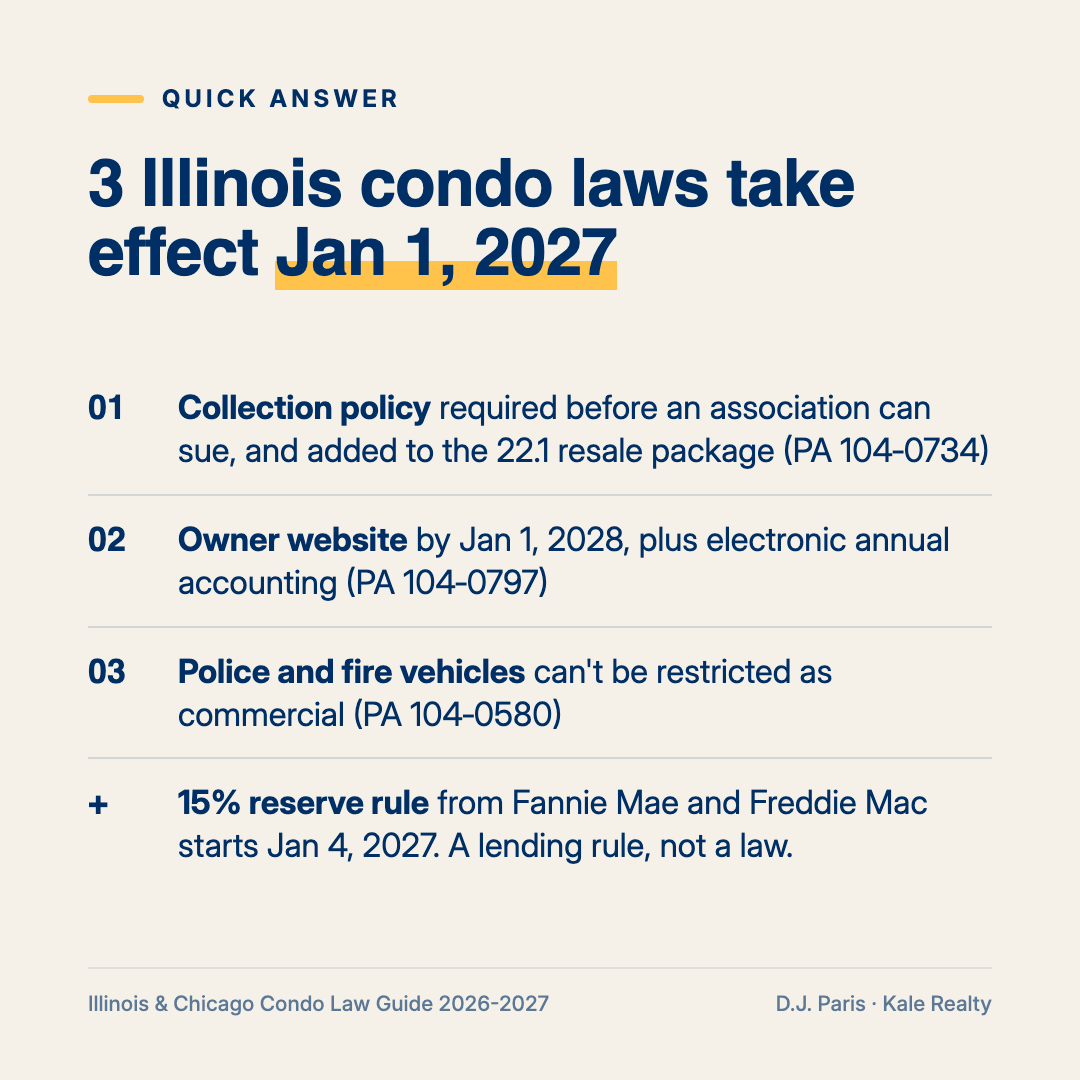
Quick answer: Three substantive amendments to the Illinois Condominium Property Act take effect January 1, 2027:
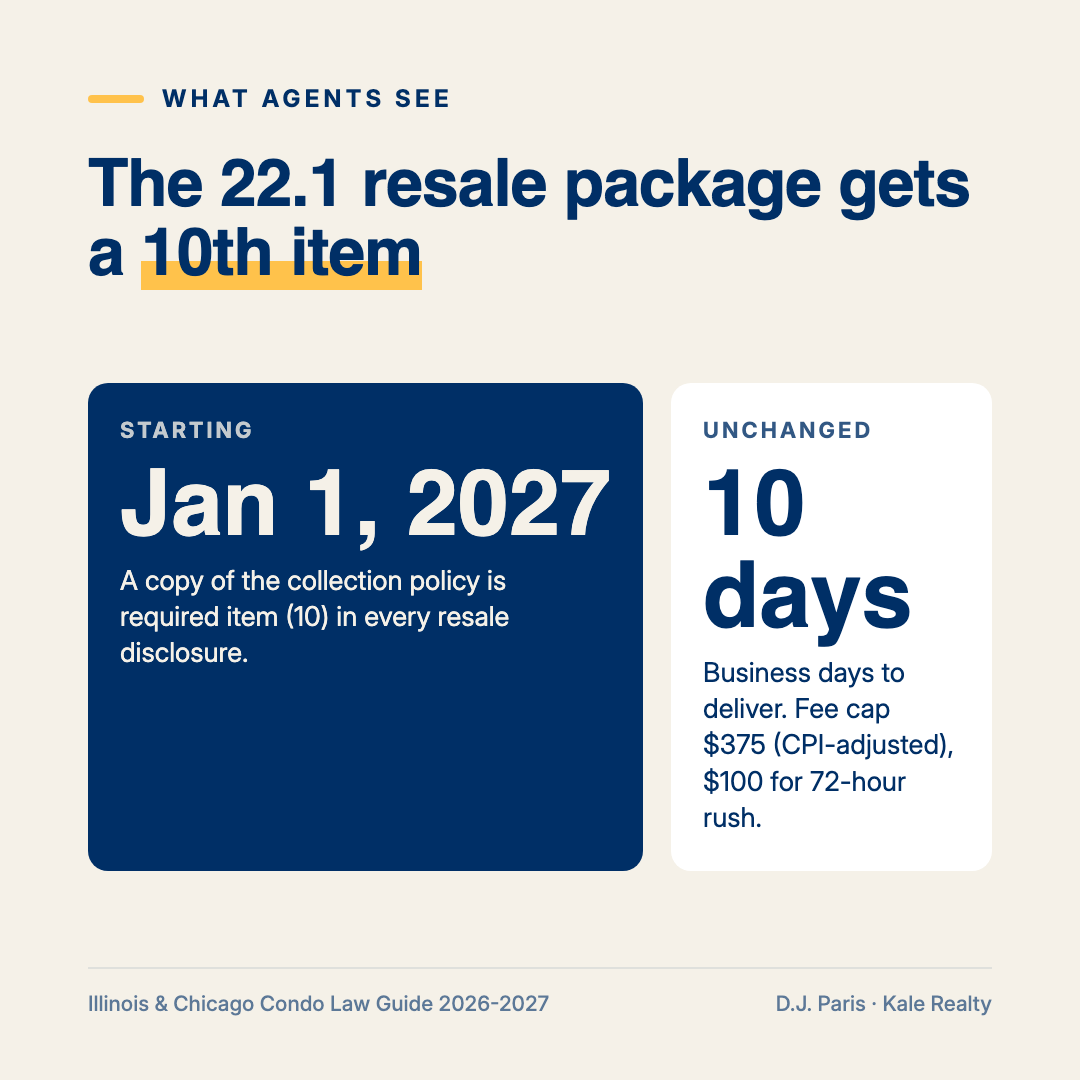
- Illinois condo associations must adopt and follow a written collection policy before suing over unpaid assessments, and that policy becomes the 10th required item in the Section 22.1 resale package (Public Act 104-0734).
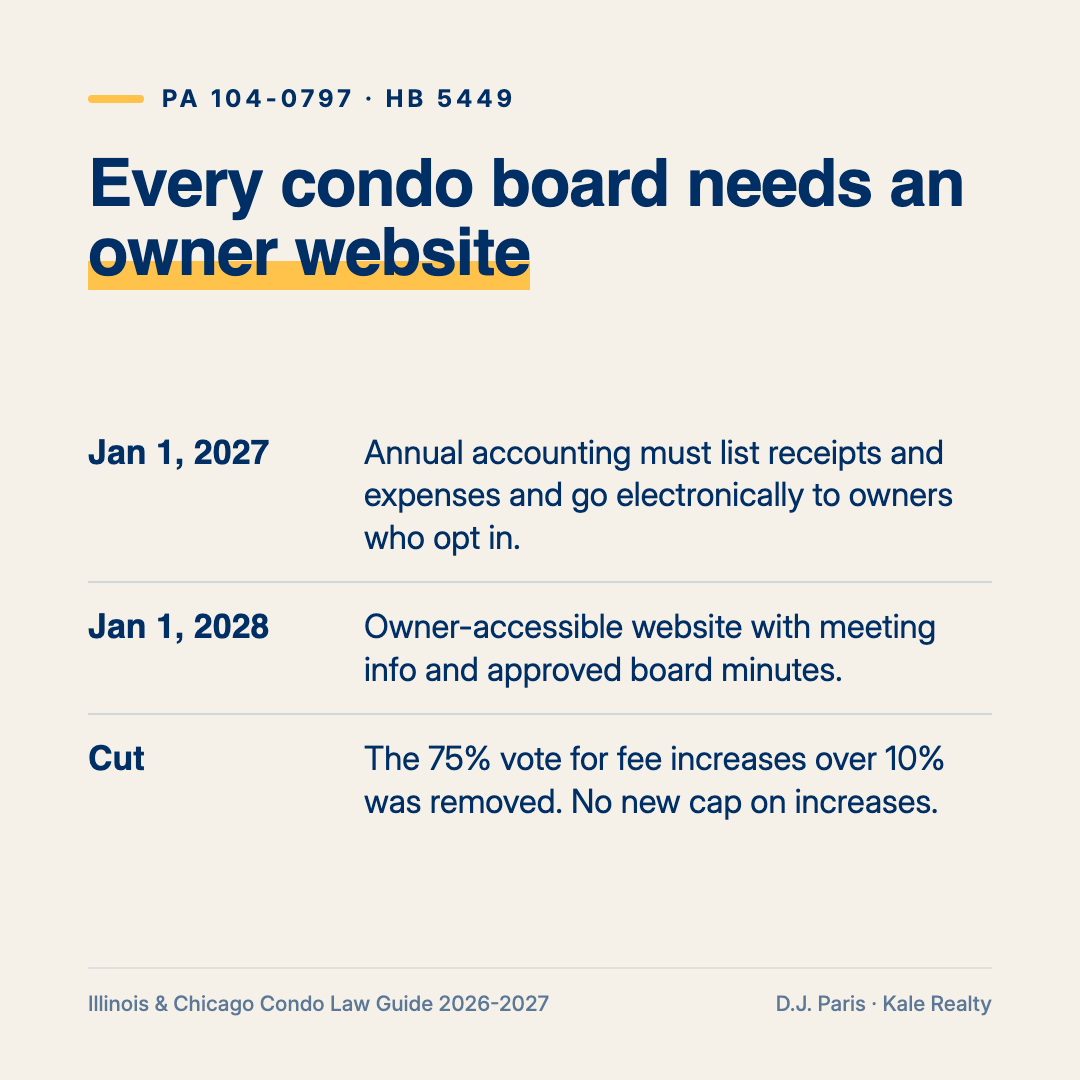
- Boards must send the annual accounting electronically to owners who opt in, and must provide an owner-accessible website by January 1, 2028 (Public Act 104-0797).
- Associations can no longer restrict marked police and fire vehicles as "commercial" vehicles (Public Act 104-0580).
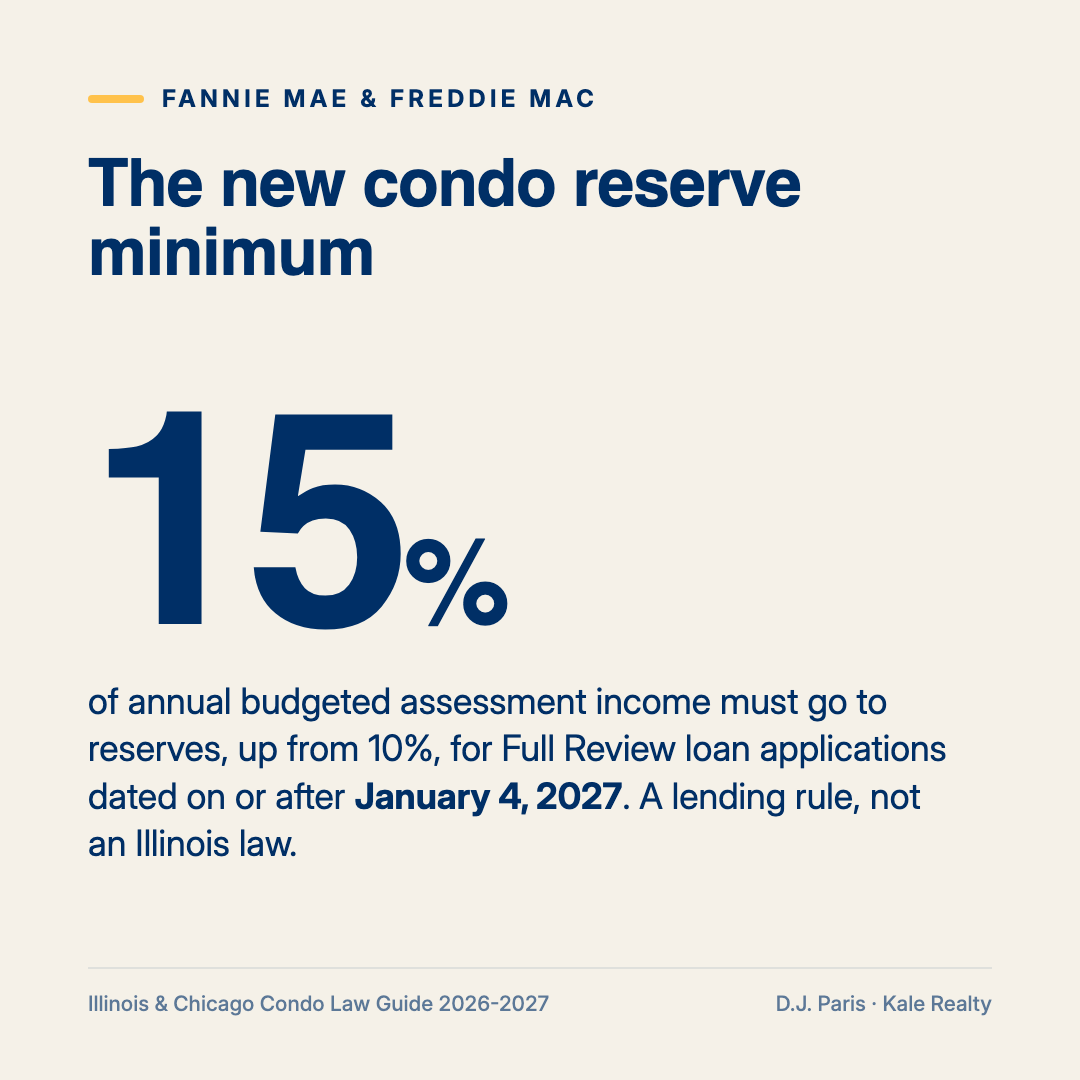
Separately, Fannie Mae and Freddie Mac raise the condo reserve minimum from 10% to 15% of budgeted assessment income for loan applications dated on or after January 4, 2027. That is a lending rule, not state law, and it affects any buyer whose conventional loan will be sold to Fannie Mae or Freddie Mac.
What did not change: Illinois still has no reserve-study mandate, the 22.1 fee cap and 10-business-day deadline are the same as in 2023, and Chicago's 85% deconversion threshold dates to 2019.
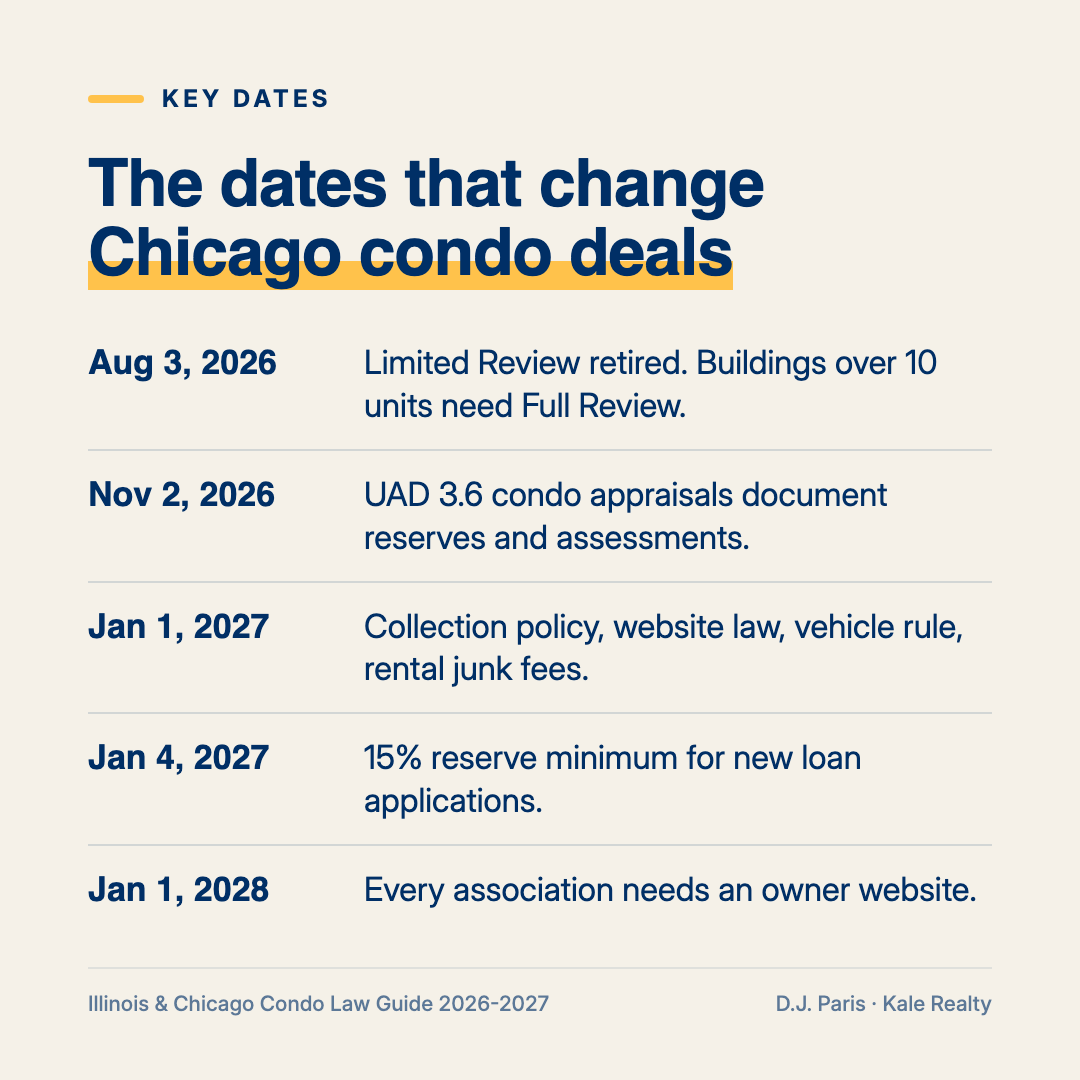
Key dates for Chicago condo transactions
- : Fannie Mae Limited Review and Freddie Mac Streamlined Review retired. Buildings over 10 units need Full Review.
- : new UAD 3.6 appraisal format; condo appraisals document reserve funding, delinquencies, special assessments and litigation.
- : collection policy required before suing, and added to the 22.1 resale package (PA 104-0734); website and electronic accounting law takes effect (PA 104-0797); police and fire vehicle protection (PA 104-0580); Illinois rental junk-fee law (PA 104-0479).
- : Fannie Mae and Freddie Mac 15% reserve minimum for loan applications dated on or after this date.
- : insurers must give 60 days' notice of homeowner renewal increases over 10% (PA 104-0752).
- : deadline for every Illinois condo association to have an owner-accessible website (PA 104-0797).
Timeline of Illinois and Chicago condo law dates, 2023 to 2032
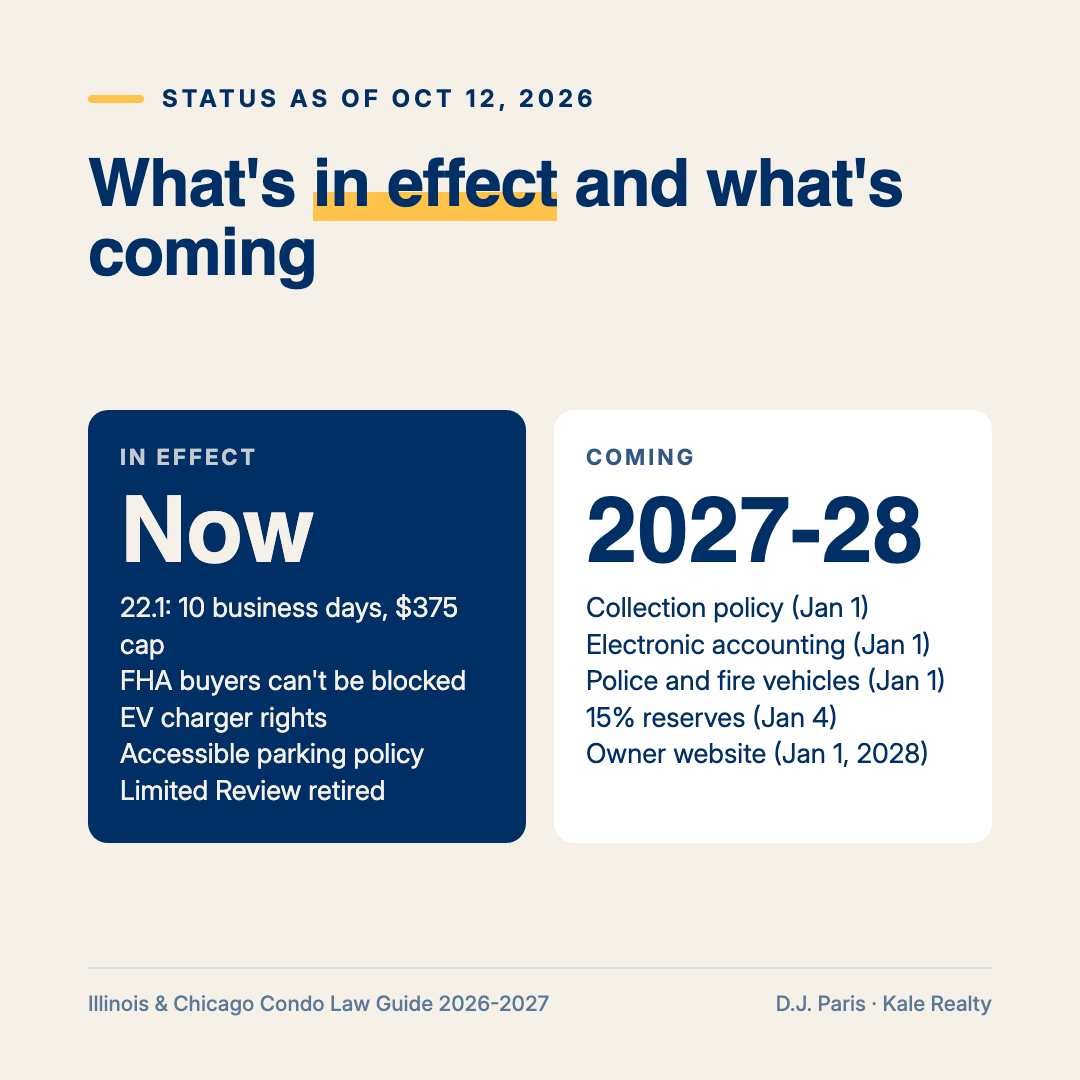
This table lists every Illinois condo statute, Chicago rule and Fannie Mae or Freddie Mac lending standard covered in this guide, in date order, with its status as of October 12, 2026.
| Effective date | Change | Source | Status |
|---|---|---|---|
| 22.1 resale info due within 10 business days; fee capped at $375 (CPI-adjusted) plus $100 for 72-hour rush | PA 102-0976 (HB 5246), 765 ILCS 605/22.1 | In effect | |
| EV Charging Act: owners can install chargers in their unit or designated space; 60-day deemed approval | PA 103-0053, 765 ILCS 1085/30 | In effect | |
| Heating and cooling standards for 55+ age-restricted condos | PA 103-0161, 765 ILCS 605/18.11 | In effect | |
| Associations cannot block a sale because the buyer uses FHA financing | PA 103-0719 (HB 5502), 765 ILCS 605/22.2 | In effect | |
| Boards must adopt an accessible-parking accommodation policy; 45-day decision | PA 103-0916 (SB 2740), 765 ILCS 605/18.12 | In effect | |
| Condo Ombudsperson program extended to Jan 1, 2029 | PA 104-0377 (SB 1383) | In effect | |
| Evictions, including assessment evictions, may not name minors; police may remove criminal trespassers | PA 104-0317; PA 104-0029 | In effect | |
| No recorder fee to record amendments removing discriminatory covenants | PA 104-0187 (HB 1575) | In effect | |
| Fannie Mae and Freddie Mac: project review waiver expanded to projects of 5 to 10 units; investor and owner-occupancy concentration limits retired | Fannie Mae LL-2026-03; Freddie Mac Bulletin 2026-C | In effect | |
| Chicago expanded ADU ordinance takes effect (not every ward or zone) | SO2024-0008918 | In effect | |
| Master policy per-unit deductible capped at $50,000; HO-6 required when the master policy has a per-unit deductible | Fannie Mae LL-2026-03; Freddie Mac Bulletin 2026-C | In effect | |
| Community association manager licensing extended to Jan 1, 2032 | PA 104-0746 (SB 3897) | In effect | |
| Limited Review and Streamlined Review retired; reserve studies must be funded at their highest recommended allocation; "baseline" funding barred | Fannie Mae LL-2026-03; Freddie Mac Bulletin 2026-C | In effect | |
| UAD 3.6 appraisal format: condo appraisals document reserve funding, delinquent assessments, special assessments and pending litigation | Fannie Mae and Freddie Mac (via Chicago Association of REALTORS) | Announced, not yet effective | |
| Chicago Phase 3 construction codes mandatory for new permit applications | Chicago Dept. of Buildings | Enacted, not yet effective | |
| Written collection policy required before suing; policy added to 22.1 package as item (10) | PA 104-0734 (SB 3527) | Enacted, not yet effective | |
| Annual accounting must include receipts and expenses and be sent electronically to opted-in owners; website law takes effect (site due by Jan 1, 2028) | PA 104-0797 (HB 5449) | Enacted, not yet effective | |
| Marked police and fire vehicles (12,000 lbs or less) can't be restricted as "commercial" | PA 104-0580 (HB 67), 765 ILCS 605/18.14 | Enacted, not yet effective | |
| Rental junk-fee law: mandatory fees on lease page 1; $50 application fee cap | PA 104-0479 as amended by PA 104-0514 | Enacted, not yet effective | |
| Homeowner policies without flood coverage must include a signed flood notice; nonrenewal notice rises from 30 to 60 days | PA 104-0534 (SB 4006) | Enacted, not yet effective | |
| Minimum reserve allocation rises from 10% to 15% of budgeted assessment income | Fannie Mae LL-2026-03; Freddie Mac Bulletin 2026-C | Announced, not yet effective | |
| Insurers must give 60 days' notice of renewal premium increases over 10% (owner-occupied residential policies) | PA 104-0752 (HB 4273) | Enacted, not yet effective | |
| Deadline for owner-accessible association website with meeting info and approved minutes | PA 104-0797 | Enacted, not yet effective | |
| Condo Ombudsperson Act repeal date | PA 104-0377 | Scheduled | |
| Community Association Manager Licensing Act repeal date | PA 104-0746 | Scheduled |
What Illinois condo laws take effect in 2027?
Three Public Acts signed in summer 2026 make substantive changes to the Illinois Condominium Property Act (765 ILCS 605) effective January 1, 2027: PA 104-0734 (collection policy), PA 104-0797 (websites and electronic accounting) and PA 104-0580 (police and fire vehicles). The collection-policy and website laws also amend the Common Interest Community Association Act (765 ILCS 160), which governs most Illinois homeowner associations. A fourth act, PA 104-0598, only updates terminology in Section 18.12.
Do Illinois condo associations need a collection policy in 2027? (PA 104-0734, SB 3527)
Yes. Starting January 1, 2027, an Illinois condo association cannot sue to collect unpaid assessments unless it has adopted, and follows, a written collection policy (Public Act 104-0734, SB 3527). The law was signed July 31, 2026 and passed the Senate 54-0 and the House 108-0.
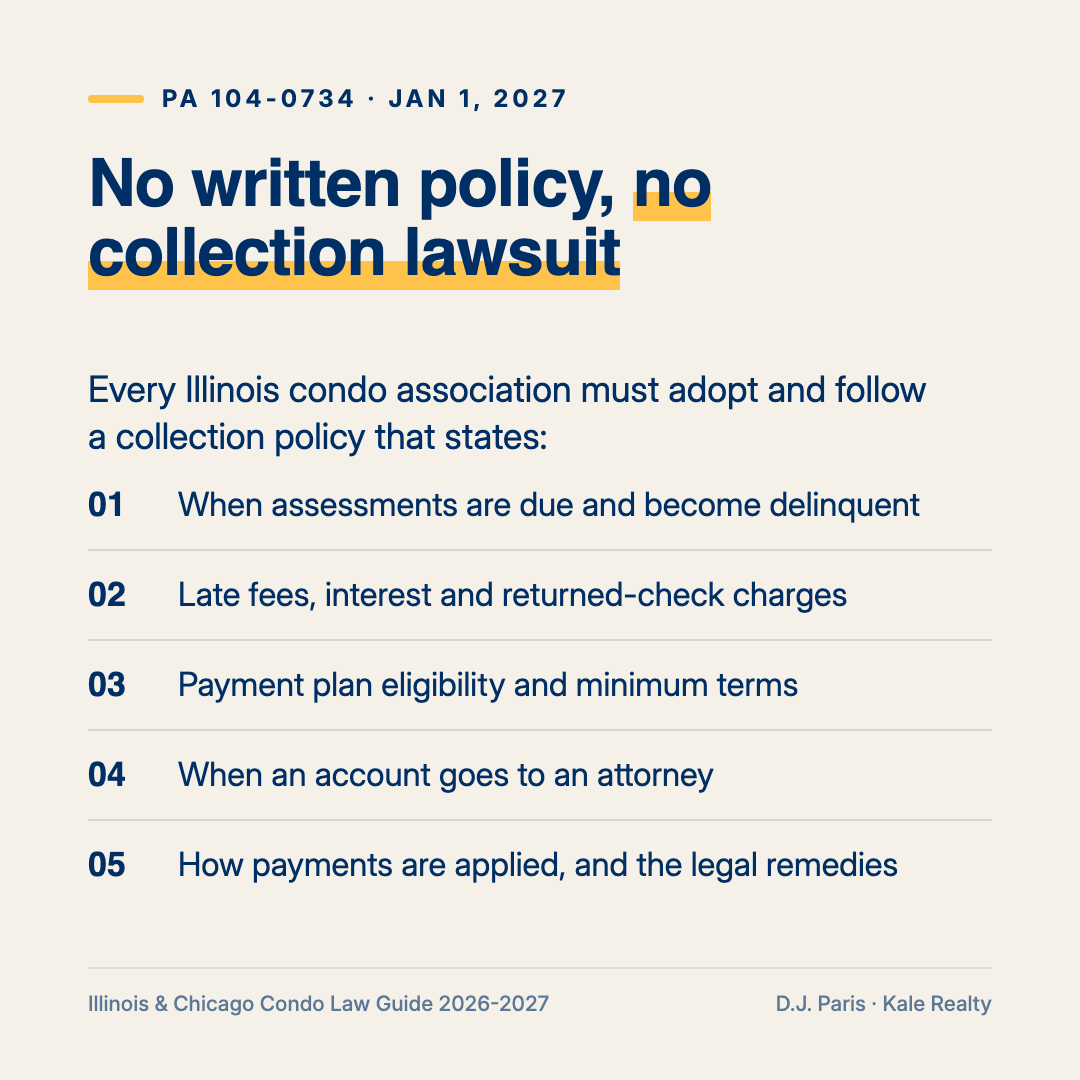
The rule covers the association and anyone holding or assigned its debt, and it overrides anything to the contrary in the declaration or rules. At minimum, the policy must state:
- When assessments are due and when an account becomes delinquent
- Late fees and interest, if any
- Returned-check charges, if any
- Whether an owner can get a payment plan, and its minimum terms
- The amount owed or time overdue before an account goes to an attorney
- How payments are applied to a delinquent account
- The legal remedies available under the governing documents and Illinois law
Why agents care: a copy of the policy becomes item (10) in the Section 22.1 resale package. Expect it in every resale disclosure requested on or after January 1, 2027. The 10-business-day delivery deadline and the fee cap do not change.
When should a condo board adopt its collection policy?
Before January 1, 2027. From that date, an association without an adopted policy cannot file a collection or eviction action for unpaid assessments. Kovitz Shifrin Nesbit advises adopting the policy as a rule. Under Section 18.4(h), adopting a rule requires an owner meeting, with notice that includes the full text. PA 104-0734 has no transition language for collection suits already on file on January 1, 2027, so boards with pending cases should ask association counsel how the law applies to them.
Source: Public Act 104-0734 · SB 3527 bill status · KSN FAQ
Do Illinois condo associations need a website? (PA 104-0797, HB 5449)
Yes. Public Act 104-0797 requires every Illinois condo board to provide an owner-accessible website with meeting information and approved board minutes by January 1, 2028. The law itself takes effect January 1, 2027. It was signed August 7, 2026, after House and Senate votes of 92-10 and 58-1 and a 117-0 House concurrence.
- Website: "The board must provide a website no later than January 1, 2028 that unit owners can access on the Internet that includes information about board and membership meetings and the approved minutes from a meeting of the board." The site does not have to be public.
- Annual accounting: the itemized annual accounting under Section 18(a)(7) must include receipts and expenses. It must be sent electronically to every owner who has given contact information and authorized electronic delivery.
- What was cut: early versions required a 75% owner vote for any fee increase over 10%, plus quarterly financial emails. Both were removed before passage. Illinois has no new cap on assessment increases.
Why agents care: once these sites exist, buyers can ask the seller for approved minutes early. Minutes are often the first place a pending special assessment, lawsuit or major repair shows up.
Source: Public Act 104-0797 · HB 5449 bill status
Can a condo association ban police or fire vehicles? (PA 104-0580, HB 67)
No. Starting January 1, 2027, Section 18.14 of the Illinois Condominium Property Act (Public Act 104-0580) bars associations from treating marked police and fire vehicles of 12,000 pounds or less as commercial vehicles. The law was signed July 24, 2026 after votes of 112-0 in the House and 59-0 in the Senate. It covers a marked vehicle "assigned to a law enforcement officer" or "assigned to a firefighter." Any rule to the contrary is void, so boards should review parking and commercial-vehicle rules before January.
Source: Public Act 104-0580
What fees can Chicago condo owners charge tenants in 2027? (PA 104-0479, HB 3564)
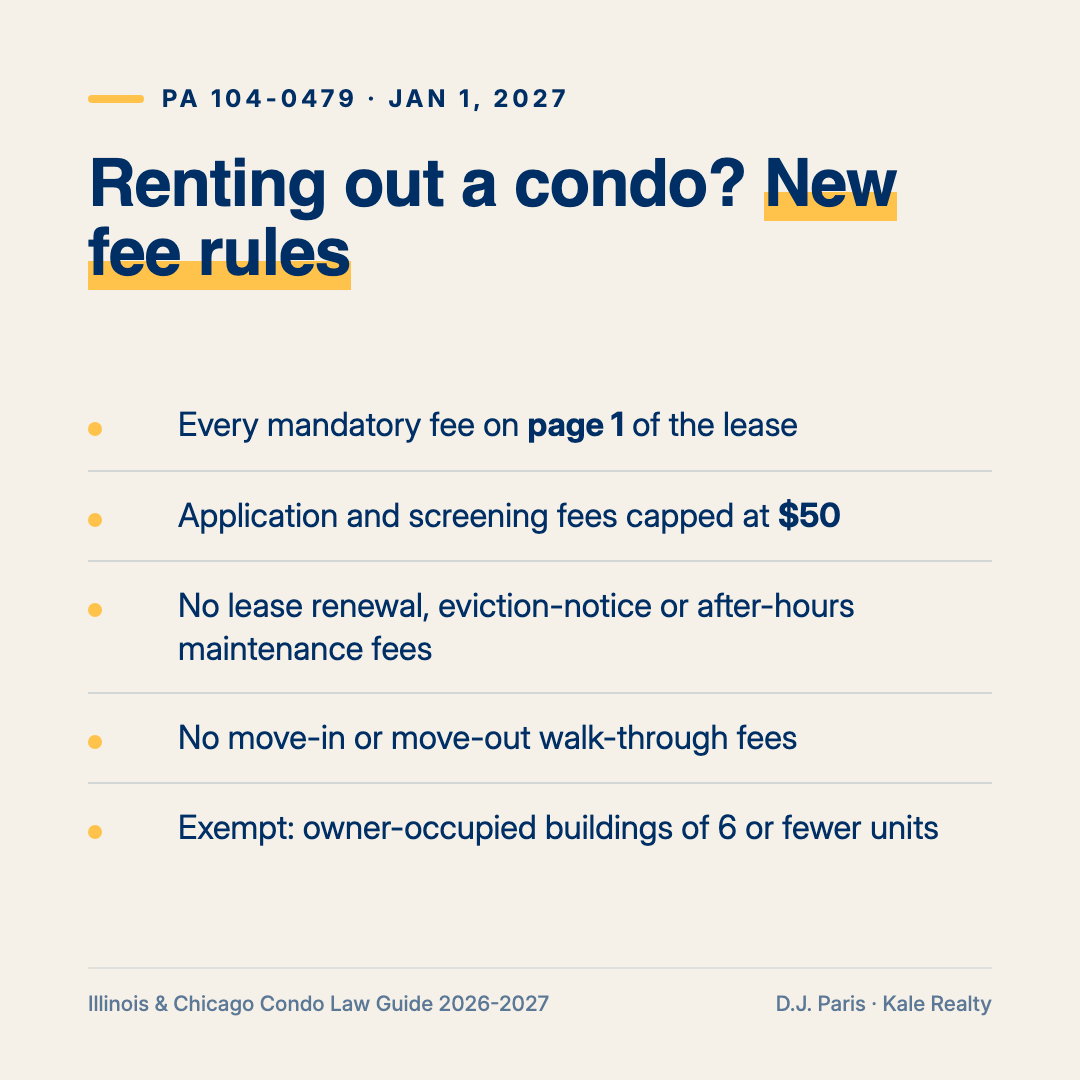
Starting January 1, 2027, the Illinois rental junk-fee law (765 ILCS 705/35) applies to leases entered into on or after that date, including leases of condo units. The enrolled bill said July 1, 2026, but Public Act 104-0514 (HB 5234) moved the date to January 1, 2027.
- Every mandatory fee must appear on the first page of the lease, or the tenant does not owe it.
- Listings must disclose non-optional fees and whether utilities are included.
- Application and screening fees are capped at $50. A landlord can recover a higher third-party background check cost only by billing the applicant within 14 days with receipts.
- Banned charges include lease renewal or modification fees, eviction-notice fees, after-hours maintenance fees, and move-in or move-out walk-through fees. Move-in fees themselves are not banned.
- Owner-occupied buildings of 6 or fewer units are exempt. Tenants can sue and recover attorney's fees.
- Chicago can regulate rental fees more strictly but not more loosely: the law sets a statewide minimum that applies to home-rule cities.
Source: Public Act 104-0479 · Public Act 104-0514
What changes for Illinois condo owners' insurance in 2027? (PA 104-0534 and PA 104-0752)
Two Illinois insurance laws add notice requirements for homeowner policies in 2027:
- January 1, 2027 (PA 104-0534, SB 4006): residential property policies without flood coverage must include a plain-language flood notice, and the insurer must get the insured's signature confirming flood options were presented. Nonrenewal notice increases from 30 to 60 days.
- July 1, 2027 (PA 104-0752, HB 4273): insurers must give at least 60 days' notice before a renewal premium increase of more than 10%. Commercial policies and policies on rented or leased structures are excluded.
Both cover residential policies on dwellings of up to four families. In our reading, that includes an owner-occupant's HO-6 policy but not the association's master policy, which is generally commercial, or an HO-6 on a rented unit under PA 104-0752. Confirm with the carrier.
Source: Public Act 104-0534 · Public Act 104-0752
Other 2027 dates for Chicago condo owners
- Property taxes: 2027 is the next City of Chicago reassessment year (Cook County Assessor). The Senior Assessment Freeze income limit is $77,000 for tax year 2027 (PA 104-0452).
- Rooftop safety: Chicago must survey buildings with skylights and other openings in low-sloped roofs by January 1, 2027 under the Rooftop Safety for First Responders Act, which sets no owner deadline or penalty (PA 104-0739).
What changed for Illinois and Chicago condos in 2026?
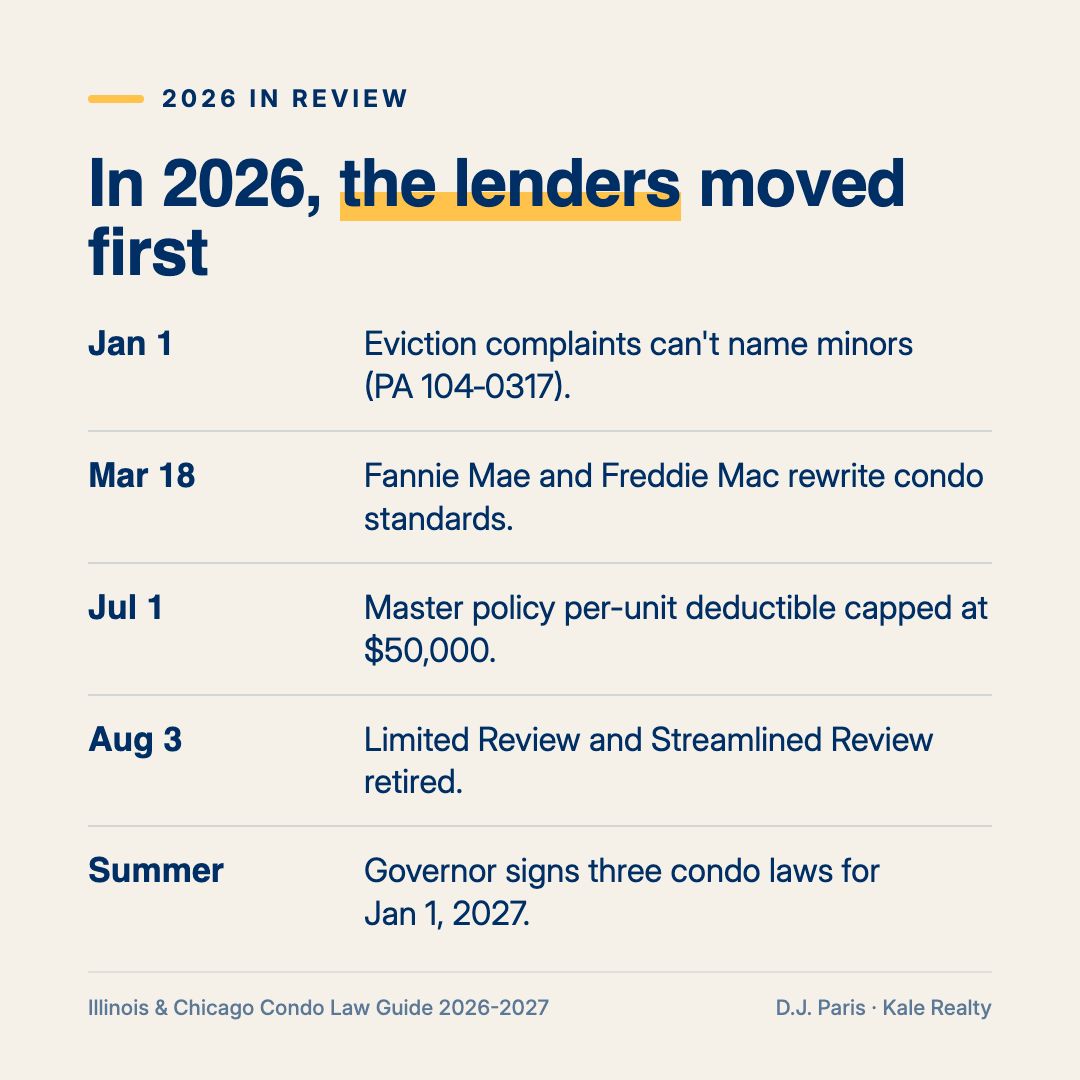
In 2026, no new Illinois statute changed condo resale rules. The biggest 2026 changes for Chicago condo sales came from Fannie Mae Lender Letter LL-2026-03 and Freddie Mac Bulletin 2026-C, both issued March 18, 2026.
- January 1, 2026: eviction complaints, including association actions for unpaid assessments, may not name minors (PA 104-0317). Police may remove criminal trespassers (PA 104-0029). Recorders may not charge to record amendments removing discriminatory covenants (PA 104-0187).
- March 18, 2026: project review waiver extended to condo buildings of 5 to 10 units; investor and owner-occupancy concentration limits retired.
- April 1, 2026: Chicago's expanded accessory dwelling unit (ADU) ordinance took effect.
- July 1, 2026: master insurance per-unit deductible capped at $50,000 for Fannie Mae and Freddie Mac loans.
- July 31, 2026: community association manager licensing extended to 2032 (PA 104-0746).
- August 3, 2026: Fannie Mae Limited Review and Freddie Mac Streamlined Review retired.
- Summer 2026: the governor signed the three condo laws that take effect January 1, 2027.
What are Fannie Mae's and Freddie Mac's new condo rules for 2026 and 2027?
Fannie Mae Lender Letter LL-2026-03 and Freddie Mac Guide Bulletin 2026-C, both dated March 18, 2026, tighten condo reserve and insurance standards and retire the lighter project reviews. These are underwriting standards, not laws. A building that misses them is still legal, but buyers there may be unable to get a conventional loan sold to Fannie Mae or Freddie Mac. Individual lenders can add stricter overlays.
| Change | Required for | What it means in Chicago |
|---|---|---|
| Waiver of Project Review expanded to new and established projects of 5 to 10 units (2 to 4 unit projects already qualified). Projects of 5 to 10 units cannot be part of a master association or larger development. | Effective immediately (Mar 18, 2026) | Many six-flat to ten-unit condo buildings can now skip project review. Check for a master association in newer developments. |
| Fannie Mae's 50% investor-concentration limit retired for established projects under Full Review | Effective immediately | Investor buyers are no longer shut out of buildings where more than half the units are rented. |
| Limited Review (Fannie Mae) and Streamlined Review (Freddie Mac) retired | Applications dated on or after Aug 3, 2026 | Established projects over 10 units now need Full Review, with a full condo questionnaire and budget review. |
| A reserve study used to qualify a project must be funded at its highest recommended allocation; "baseline" funding barred | Applications dated on or after Aug 3, 2026 | A building below the reserve minimum can still qualify with a reserve study, but only if the budget funds the study's highest recommendation. |
| Master policy per-unit deductible capped at $50,000; HO-6 required when there is a per-unit deductible | Applications dated on or after Jul 1, 2026 | Buyers' HO-6 quotes need to account for the master policy deductible. |
| Master policies may cover roofs on an actual cash value basis; the master policy otherwise still needs replacement cost coverage | Effective immediately | Buyers may need their own coverage for gaps in the master policy (per the Illinois REALTORS summary). |
| HO-6 deductible maximum: greater of 5% of coverage or $2,500 (Fannie Mae) | Effective immediately | Buyers should check their own deductible before closing. |
| Reserve allocation minimum rises from 10% to 15% of annual budgeted assessment income | Full Review applications dated on or after Jan 4, 2027 | Buildings over 10 units that budget less than 15% for reserves, and have no qualifying reserve study, may fail Full Review. |
How do I calculate a condo building's reserve percentage for Fannie Mae?
Divide the annual budgeted replacement reserve allocation by the association's annual budgeted assessment income, then multiply by 100. That is Fannie Mae's method in Selling Guide B4-2.2-02. The lender may leave out of the income figure:
- incidental income the project does not rely on for operations, maintenance or capital improvements;
- income collected for utilities owners would normally pay themselves, such as cable TV or Internet;
- income allocated to reserve accounts;
- special assessment income.
Compare the result to 10% for applications dated before January 4, 2027, and 15% for applications on or after that date. The budget is in the 22.1 package as the association's financial statement, and the reserve balance is item (4).
What does the 15% reserve rule look like in dollars?
Hypothetical building: 30 units, $300,000 in annual budgeted assessment income.
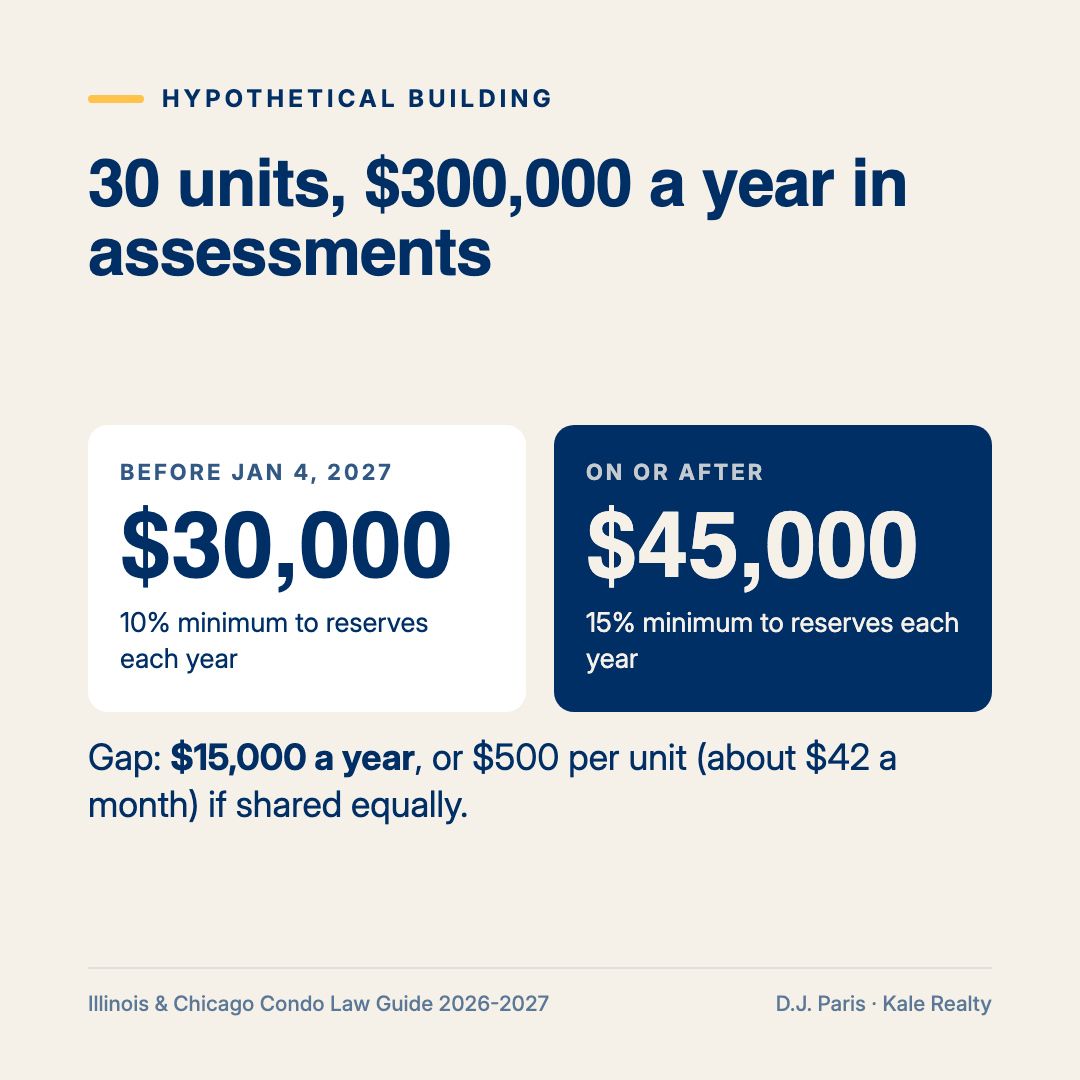
- Old 10% minimum: $30,000 a year to reserves.
- New 15% minimum: $45,000 a year to reserves.
- Gap: $15,000 a year, or $500 per unit per year (about $42 a month) if shared equally. Actual shares follow each unit's percentage of ownership.
A building can close that gap by raising assessments, moving money from other budget lines, or both. Increases above 115% of the prior year's total trigger the owner petition right described in the special assessments section.
Does the 15% reserve rule apply to FHA, VA or jumbo loans?
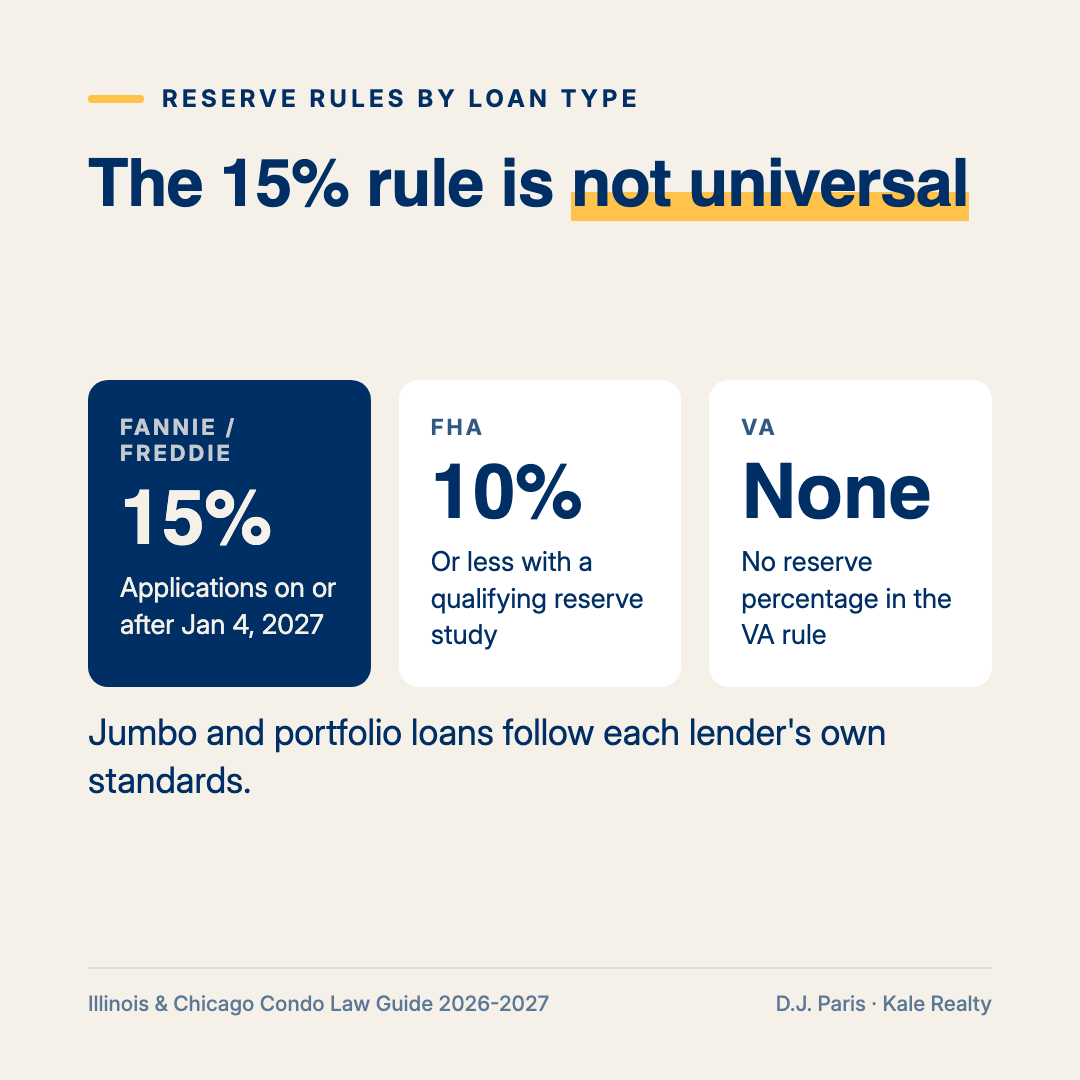
No. The 15% minimum applies to conventional loans sold to Fannie Mae or Freddie Mac. FHA condo approval still requires reserves of at least 10% of 12 months of unit assessments, unless an acceptable reserve study (36 months old or less) supports a lower amount, under HUD Handbook 4000.1. The VA's condo regulation (38 CFR 36.4360) sets no reserve percentage. Jumbo and portfolio loans follow each lender's own standards.
What will condo appraisals show starting November 2, 2026?
Starting November 2, 2026, the new UAD 3.6 appraisal format requires condo appraisals to document reserve funding, delinquent assessments, single-entity ownership, commercial space, special assessments and pending litigation, according to a Chicago Association of REALTORS webinar recap (October 7, 2026). Sellers should have those documents ready before listing.
Which Illinois condo laws are already in effect?
What is in a 22.1 disclosure package, and how long does it take?
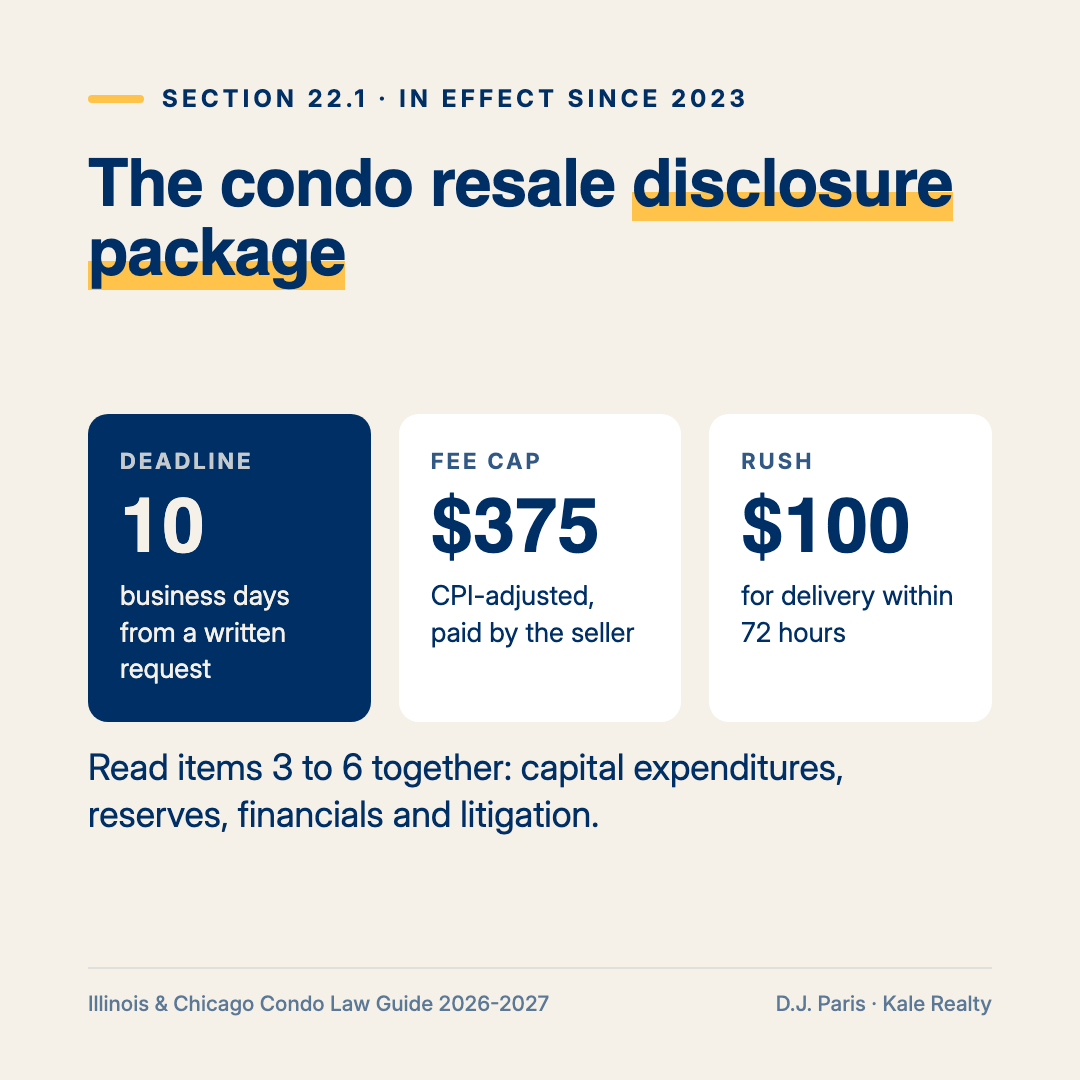
Under Section 22.1 of the Illinois Condominium Property Act, as amended by Public Act 102-0976 effective January 1, 2023, a condo association must deliver the resale disclosure package within 10 business days of a written request. The fee is capped at $375, plus $100 for rush service completed within 72 hours. The statute adjusts the $375 by CPI-U starting one year after the law took effect. The seller pays. Some older articles still say 30 days, which is out of date.
The package includes nine items today, and a tenth on January 1, 2027:
- Declaration, bylaws, other condominium instruments, and rules and regulations
- Statement of liens, including the unit's account and any unpaid assessments
- Capital expenditures anticipated in the current and next 2 fiscal years
- Status and amount of the reserve fund and any portion earmarked for a project
- Statement of financial condition for the last available fiscal year
- Pending suits or judgments involving the association
- Insurance coverage the association provides for unit owners
- Statement that the prior owner's alterations are believed in good faith to comply with the instruments
- Identity and mailing address of the principal officer or designated agent
- New January 1, 2027: copy of the collection policy (PA 104-0734)
If the board has waived reserves, Section 9(c)(2) requires that fact to be highlighted in bold in the response to a buyer's 22.1 request.
Source: PA 102-0976 · 765 ILCS 605/22.1
Can a condo board reject an FHA buyer? (Section 22.2, effective January 1, 2025)
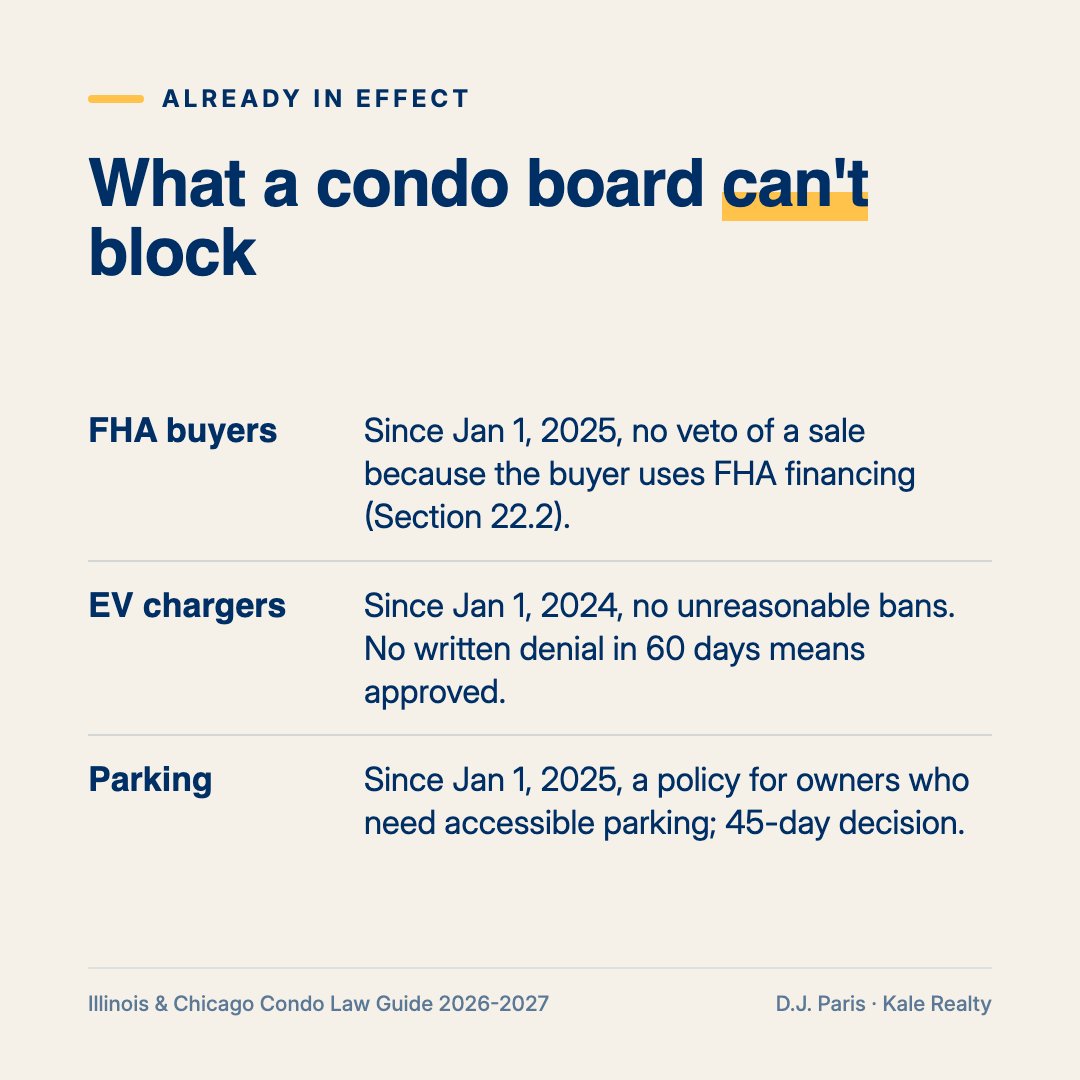
No. Since January 1, 2025, Section 22.2 of the Illinois Condominium Property Act (Public Act 103-0719) bars a condo association from blocking a sale because the buyer is using FHA financing. No association "shall exercise any right of refusal, option to purchase, or right to disapprove the sale" on that basis, or for a discriminatory or otherwise unlawful purpose. Aggrieved buyers or sellers can sue in circuit court. Some sources give July 19, 2024 as the effective date; the Illinois General Assembly lists January 1, 2025.
The law stops boards from vetoing a sale. It does not make a building FHA-approved. The building still needs FHA project approval or a single-unit approval for the loan to close.
Source: PA 103-0719
Do Illinois condo boards need an accessible parking policy? (Section 18.12, January 1, 2025)
Yes. Since January 1, 2025, every Illinois condo with parking must have a policy to reasonably accommodate an owner with a disability who needs accessible parking, and must decide requests within 45 days (Public Act 103-0916). In new construction and conversions submitted after that date, accessible spaces must stay common elements and cannot be sold as deeded parking units.
Source: PA 103-0916
Can an Illinois condo association block an EV charger? (January 1, 2024)
No. Since January 1, 2024, the Illinois Electric Vehicle Charging Act (765 ILCS 1085) voids condo rules that effectively prohibit or unreasonably restrict an owner's EV charger, including in existing buildings. Reasonable rules are allowed. An application not denied in writing within 60 days is deemed approved, unless the delay comes from a reasonable request for more information. For chargers in common or limited common areas, the owner hires a licensed, insured electrician, names the association as additional insured, pays installation and electricity, and must disclose the charger to a buyer. A willful violation can bring actual damages plus a civil penalty of up to $500.
Source: 765 ILCS 1085
Other Illinois condo-related laws already in effect
- Solar (July 28, 2023): the Homeowners' Energy Policy Statement Act limits association solar restrictions, but it does not apply to buildings over 60 feet or to roofs that are common elements, which excludes most condos (765 ILCS 165).
- 55+ condos (January 1, 2024): age-restricted condos with building-wide systems must meet heating and cooling standards, or cool a common gathering space if there is no building-wide cooling (PA 103-0161).
- Ombudsperson (August 15, 2025): the state Condominium and Common Interest Community Ombudsperson program now runs to January 1, 2029 (PA 104-0377).
- Managers (July 31, 2026): community association manager licensing now runs to January 1, 2032, and crime insurance with equivalent coverage can replace fidelity insurance (PA 104-0746).
- Evictions and covenants (January 1, 2026): see 2026 changes (PA 104-0317, PA 104-0187).
Recent Illinois condo court decisions agents should know
- Attorney's fees in collections: in 4310-4322 N. Clarendon Condominium Association v. Klein, 2026 IL App (1st) 252082, the appellate court upheld a $23,897.23 attorney-fee award against a unit owner under the Condominium Property Act, even though the owner had a court-fee waiver (Illinois REALTORS summary).
- Equal assessments: in Bogot v. Haverford HOA, 2026 IL App (1st) 250080, the court upheld equal assessments in a mixed condo and single-family association under the Common Interest Community Association Act, despite claims that some owners benefit less (Illinois REALTORS summary).
What are the Illinois rules for condo special assessments?
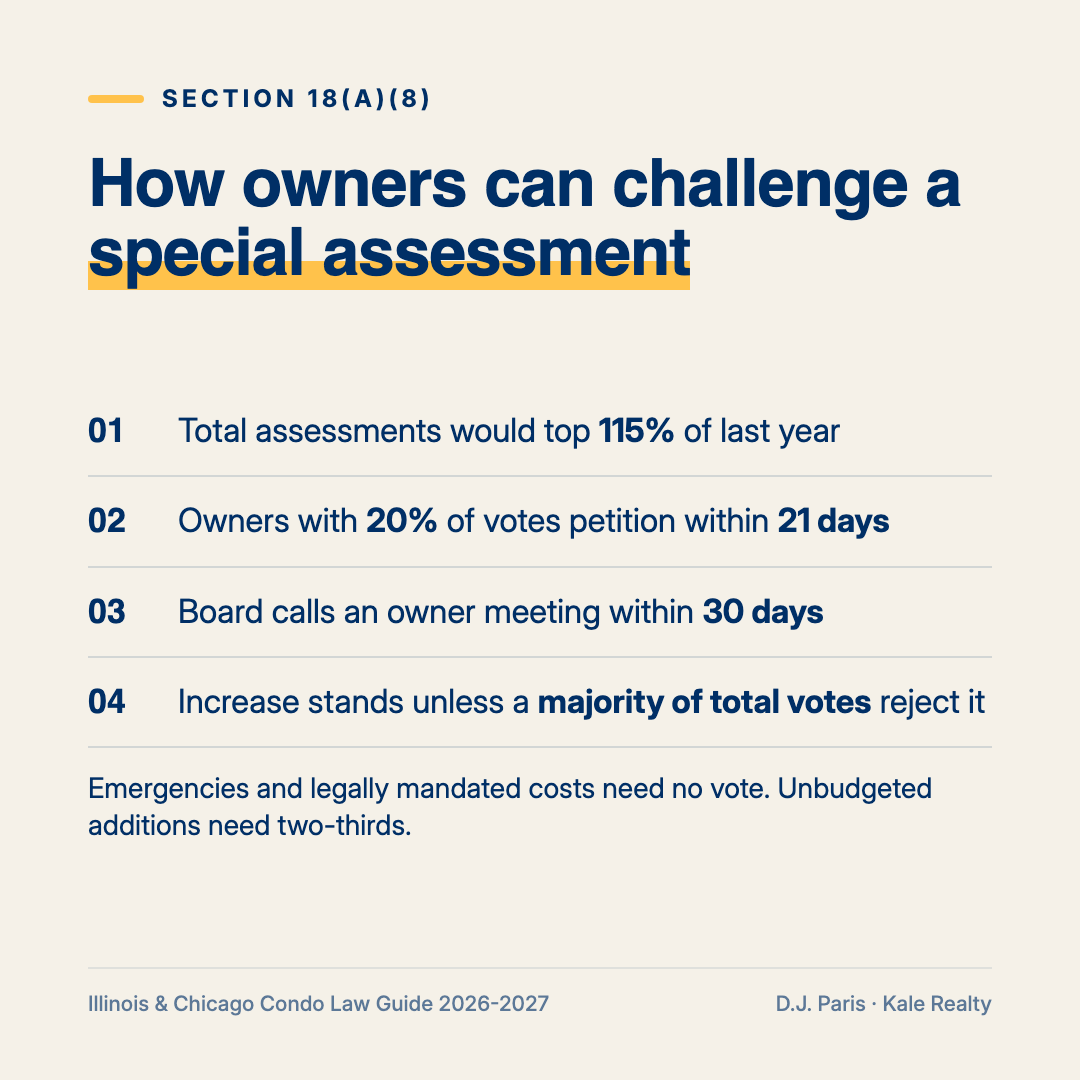
Under Section 18(a)(8) of the Illinois Condominium Property Act, a condo board can usually adopt a special assessment without an owner vote, but owners holding 20% of the votes can force a vote on any increase above 115% of the prior year's assessments. None of these rules changed in 2025 or 2026. They matter more now because many boards are raising reserves.
- Budget notice: every owner must get the proposed annual budget at least 25 days before the board adopts it, showing which portions are for reserves, capital expenditures, repairs or taxes (Section 18(a)(6)).
- The 115% petition rule: owners with 20% of the votes can petition within 21 days of the board's action. The board must call an owner meeting within 30 days, and the increase is ratified unless a majority of the total votes reject it.
- Emergencies and legal mandates: assessments for emergencies (an immediate danger to the structure or to owners' life, health, safety or property) or for expenses mandated by law need no owner approval. In our reading, the 15% reserve standard is a lending rule, not a law, so it is unlikely to count as "mandated by law." Boards should confirm with association counsel.
- Additions and alterations: a special assessment for additions or alterations to the common elements that are not in the budget requires approval by two-thirds of the total votes of all owners.
- Multi-year assessments: the board may spread a special assessment over more than one fiscal year.
- Nonpayment: unpaid assessments become a lien on the unit, and the association can bring an eviction action against the owner (Sections 9 and 9.2). From January 1, 2027, the association must have a written collection policy before suing.
Source: 765 ILCS 605/9, 9.2 and 18
Who pays a special assessment when a Chicago condo sells? (Multi-Board 8.0)
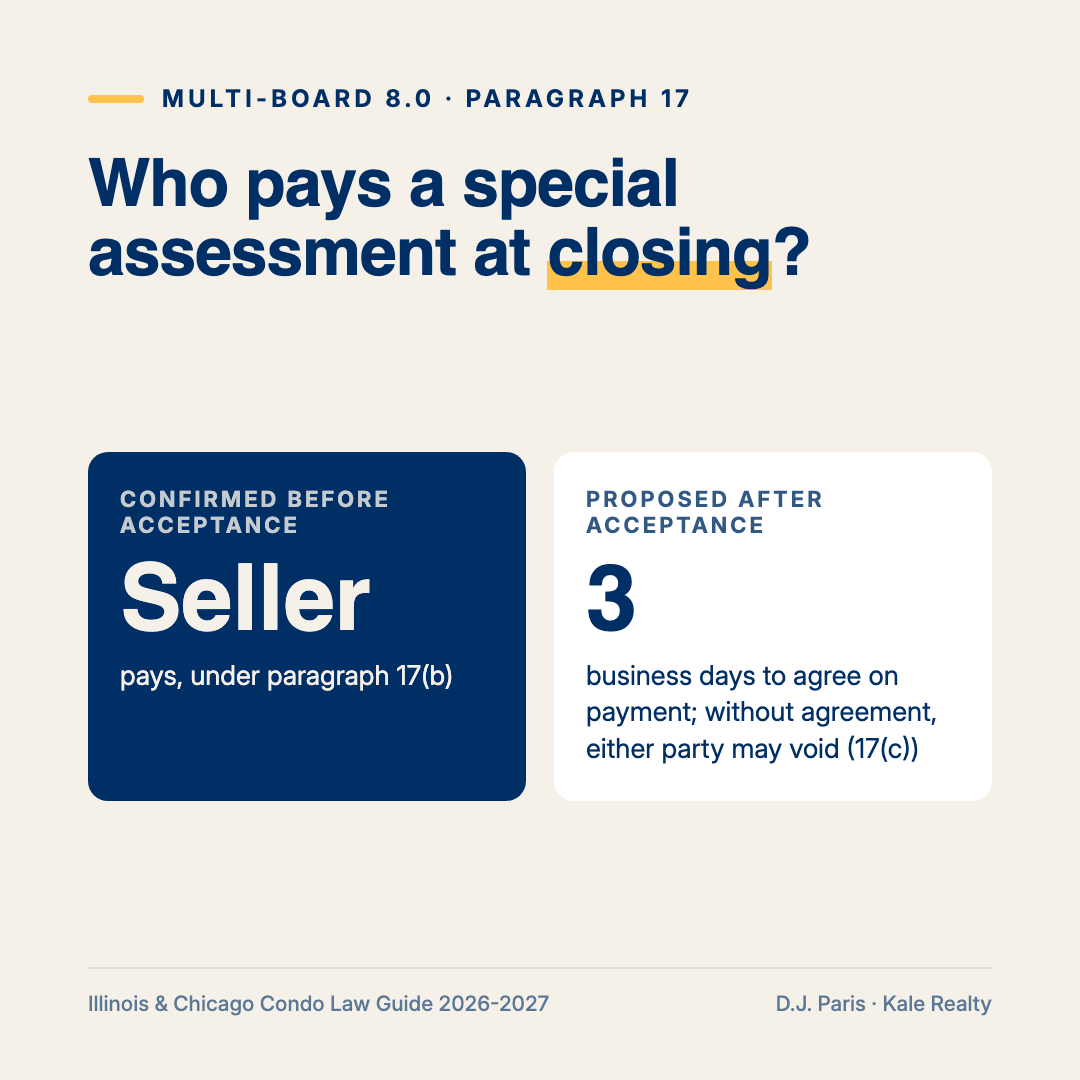
Under the Multi-Board Residential Real Estate Contract 8.0, the seller pays special assessments confirmed before the Date of Acceptance, and the parties must negotiate any special assessment proposed after acceptance. The relevant paragraphs:
- Paragraph 17(b): "Seller shall be responsible for payment of all regular assessments due and levied prior to Closing and for all special assessments confirmed prior to Date of Acceptance."
- Paragraph 17(c): the seller must notify the buyer of any proposed special assessment or regular assessment increase between acceptance and closing. The parties then have 3 business days to agree on payment; without agreement, either party may void the contract.
- Paragraph 17(d): the seller must apply for the 22.1 disclosures within 10 business days after the Date of Acceptance.
- Paragraph 17(e): the buyer may terminate if the documents show rule violations, unreasonable use restrictions, or "financial obligations unacceptable to Buyer," within the time the paragraph allows.
- Paragraph 12(c): the seller pays, at or before closing, the remaining balance of association special assessments confirmed before the Date of Acceptance.
Parties can negotiate different terms. Read the signed contract, not the default form.
Which condo rules apply only in Chicago?
Chicago condos follow the Illinois Condominium Property Act plus city rules. The most important is the 85% owner vote required to deconvert (sell) a building under Municipal Code 13-72-085.
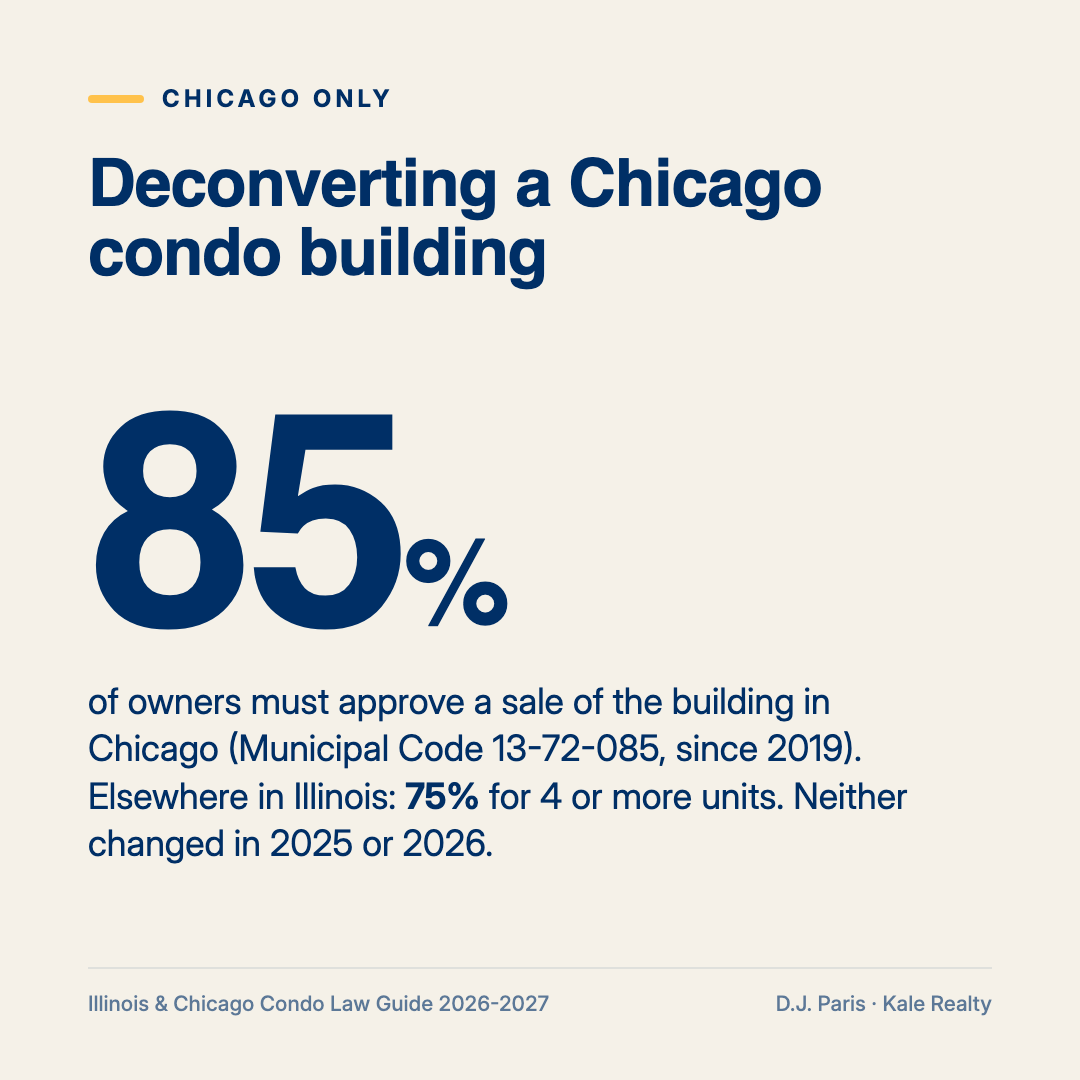
- Deconversion (forced sale): Chicago requires 85% owner approval to sell a building under Section 15 of the Act, unless the declaration requires more. The City Council passed this on September 18, 2019. Outside Chicago, the state threshold is 75% for buildings of 4 or more units, last changed in 2018.
- ADUs (April 1, 2026): Chicago's expanded accessory dwelling unit program took effect, but not in every ward or zoning district (WTTW). In a condo building, the declaration and the association still control whether a unit can be added.
- Construction codes (December 1, 2026): Chicago's Phase 3 mechanical, fuel gas and energy codes become mandatory for permit applications started on or after December 1, 2026 (Dept. of Buildings).
- Energy benchmarking: condo buildings of 50,000 square feet or more must report energy use each year by June 1 (City of Chicago).
- High-rise sprinklers: no ordinance sets a 2027 retrofit deadline. Older residential high-rises remain under Chicago's existing Life Safety Evaluation framework.
- Move-in fees: neither the Chicago Residential Landlord and Tenant Ordinance nor the new state junk-fee law bans move-in fees today. An Illinois appellate court held in 2014 that a nonrefundable move-in fee is not a security deposit under the RLTO (Steenes v. MAC Property Management). The pending Protecting Renters Ordinance would ban them.
What did not change: six claims you will see online that are wrong
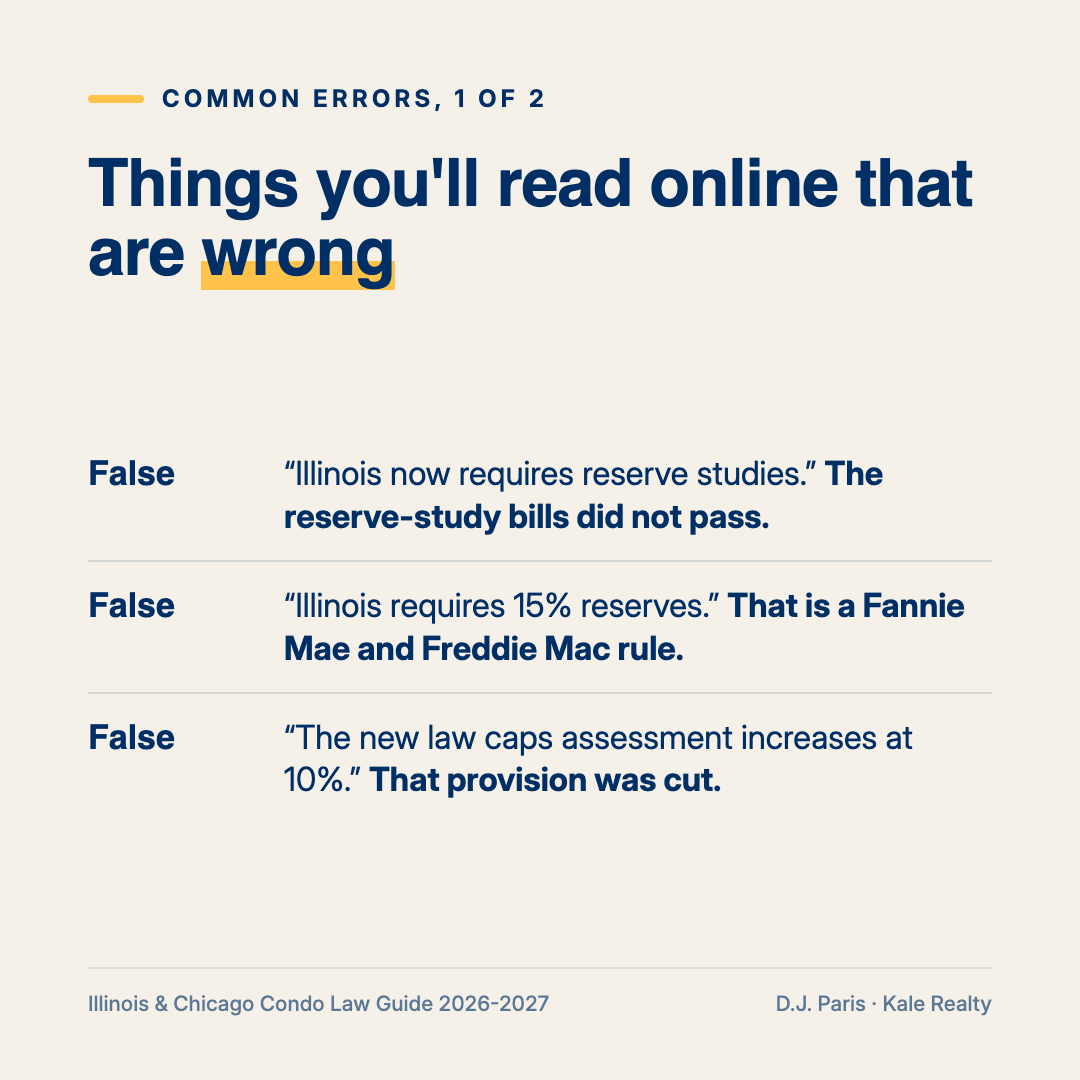
- "Illinois now requires reserve studies." False. HB 2563 and SB 3401 did not pass. Section 9(c)(2) still requires only "reasonable reserves," with a reserve study as one factor.
- "Illinois requires 15% reserves." False. The 15% figure is a Fannie Mae and Freddie Mac lending standard, starting with applications on or after January 4, 2027.
- "The new law caps assessment increases at 10%." False. That provision was removed from HB 5449 before it passed.
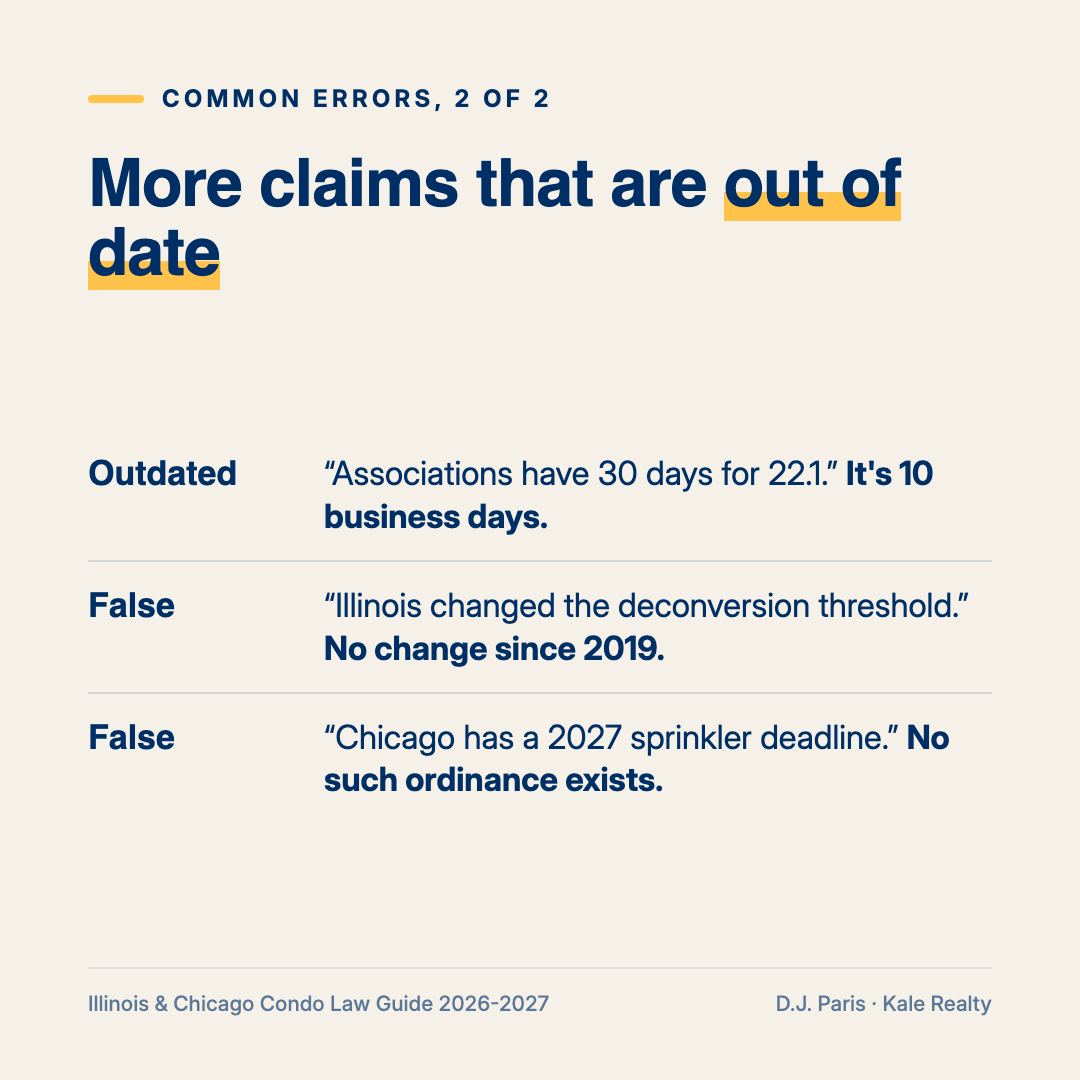
- "Associations have 30 days to deliver 22.1 documents." Outdated. It has been 10 business days since January 1, 2023.
- "Illinois changed the deconversion threshold." No change in 2025 or 2026. Chicago's 85% rule dates to 2019; the state's 75% rule last changed in 2018.
- "Chicago condos face a 2027 sprinkler or structural inspection deadline." No such Illinois law or Chicago ordinance exists. Illinois has no Florida-style milestone inspection law.
Which Illinois condo bills are still pending?
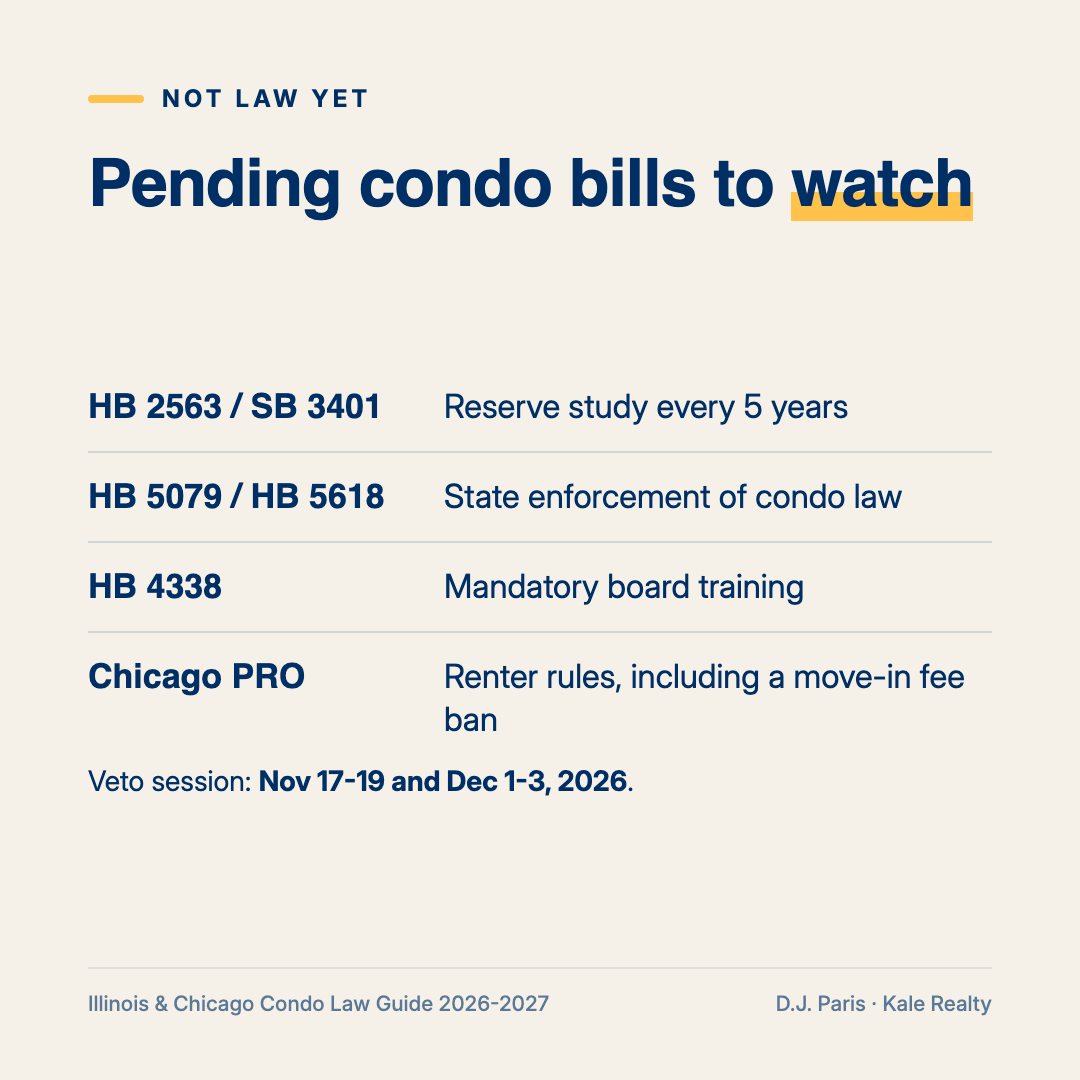
As of October 12, 2026, no Illinois reserve-study, board-training or state-enforcement bill for condos has passed both chambers. The 104th General Assembly can still act during the fall veto session ( and ) and before it adjourns in January 2027. Bills not enacted by then must be reintroduced.
| Bill | What it would do | Status |
|---|---|---|
| HB 2563 / SB 3401 | Reserve study every 5 years, available to buyers; associations of 15 or fewer units exempt | SB 3401 passed the Senate 55-0, then was re-referred to House Rules (May 15, 2026) |
| HB 5079 | IDFPR investigation of owner complaints against boards | In House Rules |
| HB 5618 | Attorney General enforcement of condo law | In House Rules |
| HB 5495 | Longer records retention; binding IDFPR determinations | In House Rules |
| HB 4617 | State registration of associations | In House Rules |
| HB 4338 | Mandatory board member training | In House Rules |
| HB 2648 / HB 5617 | Records-fee caps for common interest communities | In House Rules |
| HB 5585 | Owner protection when a unit is uninhabitable after a loss | In House Rules |
| HB 5402 | Plug-in solar on shared roofs | In House Rules |
| Chicago SO2026-0026554 (Protecting Renters Ordinance) | Amends the Chicago RLTO; would reach condo owners who rent out units, including a ban on move-in and move-out fees | Recommended by Housing Committee Sept 16, 2026; deferred and published at the Sept 23, 2026 City Council meeting |
| Chicago SO2026-0027202 (FAIR ordinance) | Competing RLTO amendment on building standards and enforcement | Recommended by Zoning Committee Sept 17, 2026; deferred and published Sept 23, 2026 |
Where Illinois REALTORS stood on these condo bills
Illinois REALTORS, the statewide REALTOR association, took public positions on several of the condo laws in this guide:
- HB 5502 (Section 22.2, FHA buyers): passed at the REALTORS' suggestion, with Community Associations of Illinois (Illinois REALTORS, January 10, 2025).
- SB 1383 (Ombudsperson extension): supported (Illinois REALTORS, August 22, 2025).
- HB 5449 (association websites): listed in March 2026 among bills where the sponsor agreed to amend the bill to remove the REALTORS' opposition (State Capitol Report, March 27, 2026).
- Fannie Mae and Freddie Mac changes: summarized for members in a May 2026 flyer (New GSE Policies Affecting Condos and HOAs).
As of October 12, 2026, we found no published coverage of PA 104-0734 (collection policy) or PA 104-0580 (police and fire vehicles) from Illinois REALTORS, the Chicago Association of REALTORS, mainstreet Organization of REALTORS or the North Shore-Barrington Association of REALTORS.
Agent playbook: what Chicago agents should do differently now
Listing a Chicago condo: seller checklist
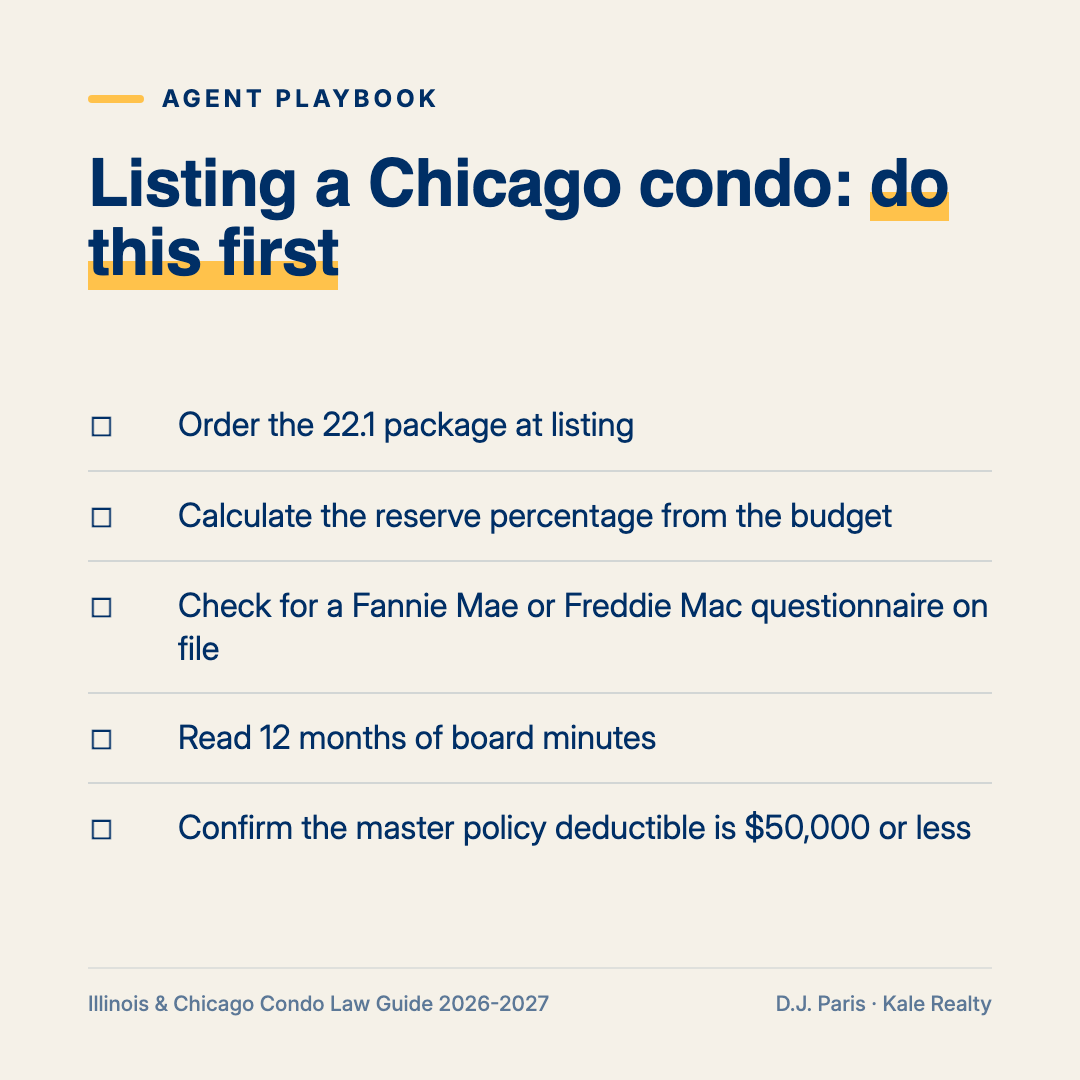
- Order the 22.1 package at listing, not after an accepted offer. Multi-Board 8.0 gives the seller 10 business days after acceptance to apply; the association then has 10 business days, or 72 hours with the $100 rush fee.
- For listings likely to close in 2027, confirm the package will include the collection policy. If the board hasn't adopted one, tell your seller early.
- Calculate the reserve percentage from the current budget (see the formula). In a building over 10 units, under 15% with no qualifying reserve study can block buyers using Fannie Mae or Freddie Mac conventional loans who apply on or after January 4, 2027.
- Ask management whether a completed Fannie Mae condo questionnaire (Form 1076) or Freddie Mac questionnaire (Form 476) is on file. Include the owner's written authorization with requests to management.
- Gather what UAD 3.6 appraisals will document: reserve funding, delinquency rate, single-entity ownership, special assessments and litigation.
- Ask about any special assessment adopted or under discussion, and read the last 12 months of approved minutes. Under Multi-Board 8.0, the seller pays special assessments confirmed before acceptance.
- Check the master insurance per-unit deductible. Over $50,000 is a Fannie Mae and Freddie Mac problem.
- If the unit has an EV charger in a common or limited common area, disclose it to buyers.
- For owner-landlords, rewrite lease templates so every mandatory fee appears on page 1 before January 1, 2027.
Representing a Chicago condo buyer: checklist
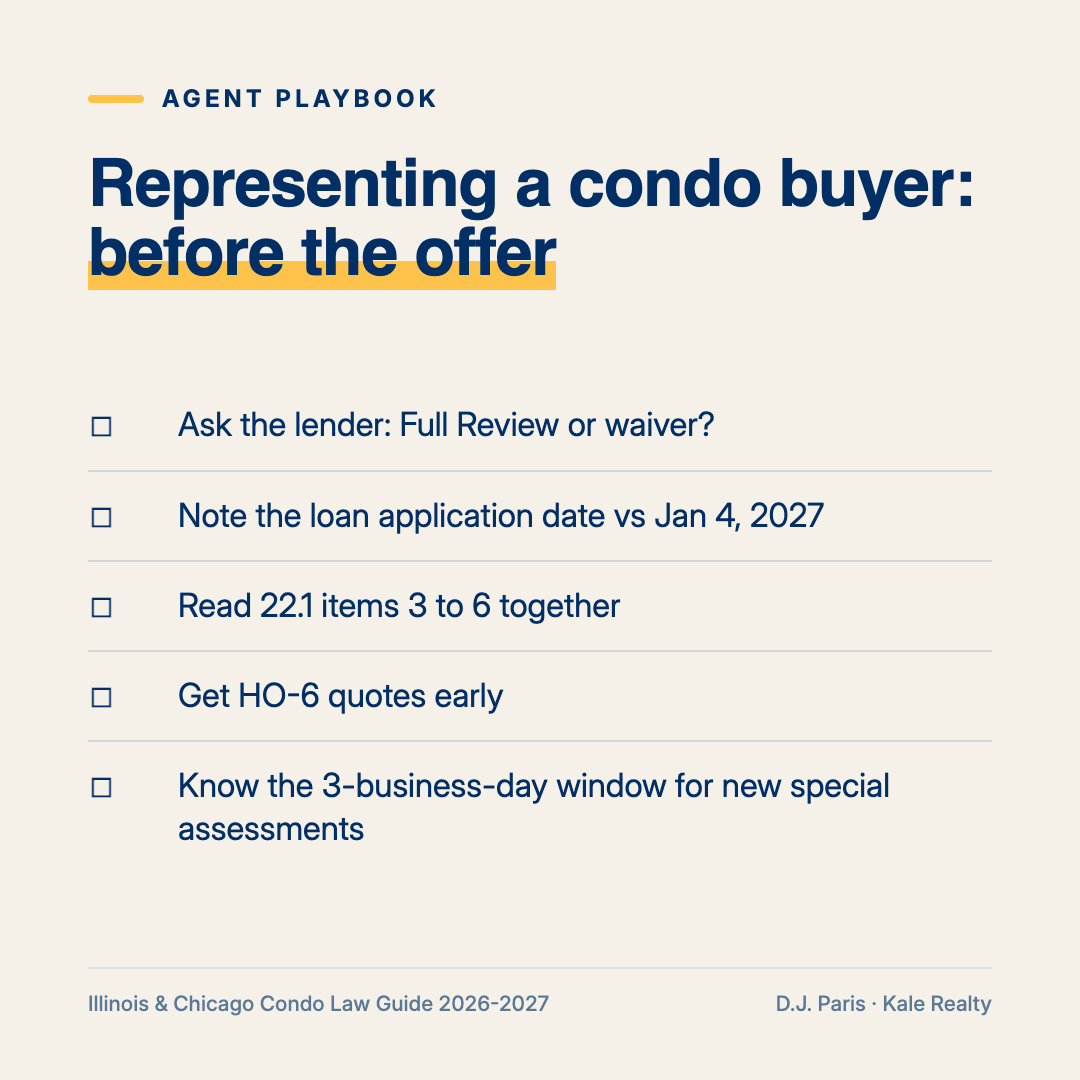
- Before writing an offer, ask the lender whether the building passes Full Review or qualifies for the 10-or-fewer-unit waiver.
- For contracts in late 2026, remember that the 15% reserve test turns on the loan application date (on or after January 4, 2027), subject to lender overlays.
- Read 22.1 items (3) capital expenditures, (4) reserves, (5) financials and (6) litigation together. They are the best early warning of a special assessment.
- Get HO-6 quotes early. The policy must account for the master policy's per-unit deductible, and the buyer's own deductible can't exceed the greater of 5% or $2,500 for Fannie Mae loans.
- If the buyer is using FHA, the board cannot block the sale for that reason (Section 22.2), but the building still needs FHA approval and FHA's 10% reserve standard still applies.
- For investor buyers, the junk-fee rules apply to leases entered into on or after January 1, 2027.
- If a special assessment is proposed after acceptance, Multi-Board 8.0 paragraph 17(c) gives the parties 3 business days to agree on payment.
- For senior buyers, the Senior Assessment Freeze income limit is $77,000 for tax year 2027.
Plain-language talking points
- To sellers: "Lenders are looking harder at condo budgets in 2027. If your building's reserves are low, we want to know before a buyer's lender finds out during underwriting."
- To buyers: "Illinois doesn't require condo buildings to hold a set amount in reserves, but Fannie Mae and Freddie Mac do for many loans starting January 4, 2027. We'll check this building's numbers before you fall in love with the unit."
- To boards: "You need a written collection policy before January 1, 2027, and it now goes to every buyer in the resale package."
Frequently asked questions about Illinois and Chicago condo law changes
What new condo laws take effect in Illinois in 2027?
Three substantive amendments to the Illinois Condominium Property Act take effect January 1, 2027. Public Act 104-0734 (SB 3527) bars associations from suing to collect assessments unless they have adopted and follow a written collection policy, and adds that policy to the Section 22.1 resale package. Public Act 104-0797 (HB 5449) requires electronic delivery of the annual accounting to owners who opt in and an owner-accessible association website by January 1, 2028. Public Act 104-0580 (HB 67) stops associations from treating marked police and fire vehicles of 12,000 pounds or less as commercial vehicles.
What condo law changes happened in Illinois in 2026?
No new Illinois statute changed condo resale rules in 2026. The biggest 2026 changes for Chicago condo sales came from Fannie Mae Lender Letter LL-2026-03 and Freddie Mac Bulletin 2026-C (March 18, 2026): the project review waiver expanded to buildings of 10 or fewer units, a $50,000 cap on master policy per-unit deductibles from July 1, 2026, and the end of Limited and Streamlined Review on August 3, 2026. Illinois also barred naming minors in eviction complaints, effective January 1, 2026.
Does Illinois require condo associations to have a reserve study?
No. As of October 12, 2026, Illinois law requires only reasonable reserves under 765 ILCS 605/9(c)(2). A reserve study is one factor a board considers, not a mandate. Bills that would have required a reserve study every five years (HB 2563 and SB 3401) did not pass both chambers.
What is the 15% condo reserve rule and is it an Illinois law?
It is a Fannie Mae and Freddie Mac lending rule, not an Illinois law. For Full Review loan applications dated on or after January 4, 2027, a condo budget must allocate at least 15% of annual budgeted assessment income to reserves, up from 10%. A building that budgets less is still legal, but buyers there may not get a conventional loan sold to Fannie Mae or Freddie Mac unless the building qualifies through a reserve study funded at its highest recommended level.
Does the 15% reserve rule apply to FHA loans?
No. FHA condo approval still requires reserves of at least 10% of 12 months of unit assessments, or a lower amount supported by an acceptable reserve study no more than 36 months old, under HUD Handbook 4000.1. The 15% minimum applies only to conventional loans sold to Fannie Mae or Freddie Mac.
How long does a condo association have to provide 22.1 disclosures, and what can it charge?
An Illinois condo association must provide the Section 22.1 resale information within 10 business days of a written request. The fee is capped at $375, adjusted by CPI-U under the statute, plus $100 for rush service completed within 72 hours. The seller pays. These rules have been in effect since January 1, 2023 (Public Act 102-0976).
What happens if the condo association misses the 22.1 deadline?
Section 22.1 of the Illinois Condominium Property Act sets the 10-business-day deadline but names no penalty or buyer remedy for missing it. In practice, the purchase contract governs: Multi-Board 8.0 paragraph 17(d) requires the seller to apply for the disclosures within 10 business days after acceptance and provide them no later than the time the law allows.
What is changing in the 22.1 resale package in 2027?
Starting January 1, 2027, Section 22.1(a)(10) adds a tenth required item: a copy of the association's written collection policy. The 10-business-day deadline and the fee cap do not change.
Can a Chicago condo association reject a buyer who is using an FHA loan?
No. Since January 1, 2025, Section 22.2 of the Illinois Condominium Property Act (Public Act 103-0719) bars associations from using a right of first refusal, option to purchase, or right to disapprove a sale because the buyer's financing is FHA-guaranteed, or for a discriminatory or otherwise unlawful purpose. An aggrieved person can sue in circuit court. This does not make the building FHA-approved; it only stops the board from blocking the sale on that basis.
Who pays a special assessment when a condo sells in Chicago?
Under the Multi-Board Residential Real Estate Contract 8.0, the seller pays special assessments confirmed before the Date of Acceptance (paragraph 17(b)). If a special assessment is proposed between acceptance and closing, the parties have 3 business days to agree on payment, and either party may void the contract without agreement (paragraph 17(c)). The parties can negotiate different terms.
Can a condo board levy a special assessment without an owner vote in Illinois?
Yes, in most cases. Under 765 ILCS 605/18(a)(8), an Illinois condo board can adopt a special assessment without an owner vote, but if total assessments would exceed 115% of the prior year, owners with 20% of the votes can petition within 21 days for a meeting, and a majority of the total votes can reject the increase. Assessments for emergencies or for expenses mandated by law need no owner approval. Assessments for additions or alterations not in the budget need approval from two-thirds of the total votes.
What percentage of owners is needed to force the sale of a Chicago condo building?
In Chicago, 85% of owners must approve, under a 2019 city ordinance (Municipal Code 13-72-085), unless the declaration requires more. Outside Chicago, state law (765 ILCS 605/15) requires 75% for buildings with 4 or more units. Neither threshold changed in 2025 or 2026.
Do Illinois condo associations have to have a website?
Yes, by January 1, 2028. Public Act 104-0797, effective January 1, 2027, requires every Illinois condo board to provide a website that unit owners can access on the Internet, with information about board and membership meetings and approved board minutes. The site does not have to be open to the public.
Did Fannie Mae eliminate Limited Review for condos?
Yes. Fannie Mae Lender Letter LL-2026-03 retired Limited Review for all loan applications dated on or after August 3, 2026, and Freddie Mac retired Streamlined Review on the same date. Established projects now go through Full Review unless they qualify for a Waiver of Project Review, which now covers projects of 10 or fewer units. Projects of 5 to 10 units qualify only if they are not part of a master association or larger development.
What is a non-warrantable condo in Chicago?
A non-warrantable condo is in a building that does not meet Fannie Mae or Freddie Mac project standards, so buyers cannot get a conventional loan sold to those agencies. Common triggers include reserves under 15% of budgeted assessment income for applications on or after January 4, 2027 (without a qualifying reserve study) and a master insurance per-unit deductible over $50,000. Buyers in non-warrantable buildings typically need portfolio or other non-agency financing.
Can a condo association block an owner from installing an EV charger in Illinois?
No. Under the Illinois Electric Vehicle Charging Act (765 ILCS 1085/30), effective January 1, 2024 for new and existing buildings, rules that effectively prohibit or unreasonably restrict a charger in an owner's unit or designated parking space are void. Reasonable rules are allowed. An application not denied in writing within 60 days is deemed approved, unless the delay comes from a reasonable request for more information.
Does the Illinois rental junk-fee law apply to Chicago condo owners who rent out units?
Yes, for leases entered into on or after January 1, 2027, unless the owner lives in a building of 6 or fewer units. Mandatory fees must appear on page 1 of the lease, application fees are capped at $50, and fees for lease renewals, eviction notices, after-hours maintenance and move-in or move-out walk-throughs are banned (765 ILCS 705/35). Chicago may regulate more strictly but not more loosely.
What happens if a condo owner doesn't pay assessments in Illinois?
Unpaid assessments become a lien on the unit, and the association can bring an eviction action against the owner under Sections 9 and 9.2 of the Illinois Condominium Property Act. Starting January 1, 2027, the association must have adopted and follow a written collection policy before it takes legal action (Public Act 104-0734).
How do I get condo association records in Illinois?
An Illinois condo owner can inspect and copy association records by sending the board a written request that specifies the records. Under Section 19 of the Illinois Condominium Property Act, failure to make them available within 10 business days is treated as a denial, and an owner who wins an enforcement action for most record types can recover attorney's fees.
Can an Illinois condo association restrict rentals?
Yes, if the declaration and bylaws allow it; Illinois has no statewide rental cap. Under Section 18(n) of the Illinois Condominium Property Act, every lease is subject to the condominium instruments and rules, and the owner must give the board a copy of the signed lease by the earlier of the occupancy date or 10 days after signing. The association can seek to evict a tenant for violations.
Is there a Chicago high-rise sprinkler retrofit deadline in 2027?
No. As of October 12, 2026, no Chicago ordinance sets a 2027 sprinkler retrofit deadline for existing residential high-rises. Older residential high-rises remain under Chicago's existing Life Safety Evaluation framework.
Sources and update log
Illinois statutes and Public Acts were checked against ilga.gov, and lending rules against Fannie Mae, Freddie Mac and HUD documents, on October 12, 2026. Chicago items rely on city records and news sources as linked.
- Illinois Condominium Property Act, 765 ILCS 605 (current compilation)
- Public Act 104-0734 (SB 3527), collection policy
- Public Act 104-0797 (HB 5449), websites and financial statements
- Public Act 104-0580 (HB 67), police and fire vehicles
- Public Act 104-0479 (HB 3564) and Public Act 104-0514 (HB 5234), rental fees
- Public Act 104-0534 (SB 4006) and Public Act 104-0752 (HB 4273), insurance
- Public Act 102-0976 (HB 5246), 22.1 timing and fees
- Public Act 103-0719 (HB 5502), Section 22.2 FHA protection
- Public Act 103-0916 (SB 2740), accessible parking
- Public Act 104-0377 (SB 1383), Ombudsperson extension
- Public Act 104-0746 (SB 3897), manager licensing
- Electric Vehicle Charging Act, 765 ILCS 1085
- Fannie Mae Lender Letter LL-2026-03 (March 18, 2026)
- Fannie Mae Selling Guide B4-2.2-02, Full Review
- Freddie Mac Guide Bulletin 2026-C (March 18, 2026)
- HUD Handbook 4000.1, condominium project approval
- Multi-Board Residential Real Estate Contract 8.0
- Illinois REALTORS, New GSE Policies Affecting Condos and HOAs (May 2026)
- Chicago Association of REALTORS, UAD 3.6 webinar recap (October 7, 2026)
- Illinois Senate 2026 veto session calendar
- Cook County Assessor, reassessment schedule
- Chicago Department of Buildings, Phase 3 code update
- Chicago Energy Benchmarking
- CAI 2026 Illinois end-of-session report (bill status)
- Kovitz Shifrin Nesbit, collection policy FAQ
Update log
- : Published. Covers Illinois Public Acts through 104-0854 and Chicago City Council actions through September 29, 2026.
This guide is general information, not legal advice. Statutes and lending guidelines change. Confirm current requirements with a real estate attorney, the association's counsel or the lender before acting.