
The Pre-Listing Box: What to Send a Seller Before the Listing Appointment (2026)
Chris, an agent in Idaho, closed 73 sales last year. Before every listing appointment, he sends the seller a box. It gets to the house before he does, so by the time he shows up the seller has already seen why they'd hire him. Here's the box.

Every piece of the box is a free template. One PDF: Canva designs for the outside of the box in two sizes, the five templates that go inside, four bonus templates for after the seller signs, and a short guide for putting your name, photo, and logo on all of it. No email required. See what goes inside.
Editing in Canva is easier on a computer. On your phone? Email yourself the link and finish it at your desk.
- The box arrives before the appointment, so the seller sees your case before any agent is in the room.
- Five things go in the box. A handwritten note, the pre-listing packet, a questionnaire, a CMA, and a one-page flyer.
- Put the price in the box. The CMA shows the seller your range before you arrive.
- Keep a few built ahead of time. Appointments that book for tomorrow are the ones you'll want a box for most.
- Save four templates for after they sign. The prep guide, staging checklist, showing instructions, and timeline are a bonus for your new client.
On this page
The real problem: you lost that listing before you walked in the door
Most of the work agents put into a listing appointment goes into the hour at the kitchen table. The presentation, the comps, the answers to the questions they know are coming.
But the seller didn't wait for that hour to start forming an opinion. Before you ring the bell, they may have Googled you, read your reviews, or talked to another agent. You're often walking into a room that's already leaning one way.
The fix is getting something in front of the seller before the appointment. Chris does it with a box, and he says he almost never competes for a listing. The competing agent never knows it showed up.
Move 1: build the outside of the box
The outside is what makes it a box and not a mailer. It should look like it came from a professional before anybody opens it.
The templates come in two sizes:
- 12 x 10 x 4 inches. Room for the booklets, the flyer, and a small gift.
- 12 x 9 x 2 inches. A flatter box for paper only, and cheaper to ship.
Each size has three templates: the cover, the left and right sides, and the front and back. Open the PDF, tap a button on page one, and the template opens in Canva. Sign in with a free Canva account and it's yours to edit. Page two has the templates that go in the box, page three has the bonus templates, and the rest of the PDF walks through setting up a brand kit, so your colors and fonts apply to every template at once.
Put four things on it: your photo, your name, your phone number, and your brokerage's name. Every state has rules about advertising, and a box with your face on it is advertising. In Illinois, it has to carry your sponsoring brokerage's business name, at least as large as your own name or team name, and a logo without the name doesn't count. Show the finished design to your managing broker before you print it.
Then get it printed. If you only have a handful of listing appointments a year, start with the label version: print the panels as labels and put them on a plain box from the store. Order custom printed mailer boxes once you know you'll use them, since most printers have a minimum order.
Move 2: what goes in the box
Five things go in the box: a handwritten note, the pre-listing packet, the questionnaire, the CMA, and the flyer. All but the note are Canva templates on page two of the PDF, so you're swapping in names, photos, and numbers, not designing anything. Four more templates come as a bonus for after they sign. Holding those back keeps the box short enough to read, and it gives you something to hand over right after they hire you.
One rule before you open any of them. Every template comes filled with a sample agent, sample text, and sample numbers. Your photo, name, and colors replace hers once you set up the brand kit. Replace every number with your own before anything prints, and if you don't have a real number for a section, delete the section. A made-up statistic in front of a seller is advertising, and advertising has to be true. The samples also say "REALTOR®," so remove it unless you're a member of the National Association of REALTORS®.
Jump to: Packet · Questionnaire · CMA · Net sheet · Flyer · Note and gift · Bonus templates
The pre-listing packet (29 pages, so cut it down)
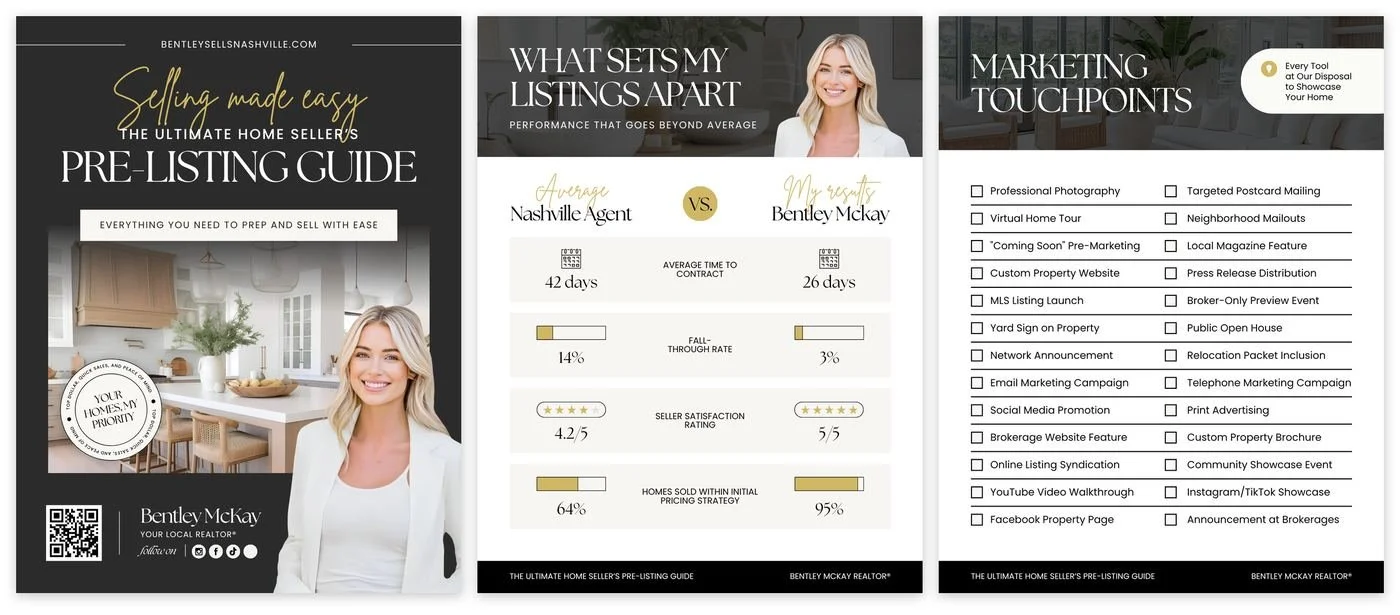
It opens with a letter to the homeowner, then introduces you. There are two versions of the "meet your agent" page: one for experienced agents and one marked for newer agents. Use the one that's true. The team pages are for teams, so delete them if that's not you.
Then come local market insights, case studies of homes you've sold with list price, sale price, and days on market, your marketing plan, how selling with you works, and client reviews. The last pages prepare the seller for the appointment, including a list of documents to gather.
Keep the pages you can fill with real information and cut the rest. Four pages need extra care:
- "What sets my listings apart" compares you with area averages on days to contract, fall-through rate, a satisfaction rating, and homes sold at the first price. Your MLS can give you days to contract. It doesn't track satisfaction ratings, or fall-through rates for your area, so delete any row you can't source for both you and the area. Label what's left with the source, the dates, and the area, and follow your MLS's rules for citing its data.
- The case studies should say whether you represented the seller or the buyer.
- The letter and the closing page ask for a name and an appointment date. If you print packets in batches, make both generic and put your handwritten note on top instead.
- The improvements and home-value worksheets ask the same things as the questionnaire. If the questionnaire is in the box, cut them.
The pre-listing questionnaire (12 pages)
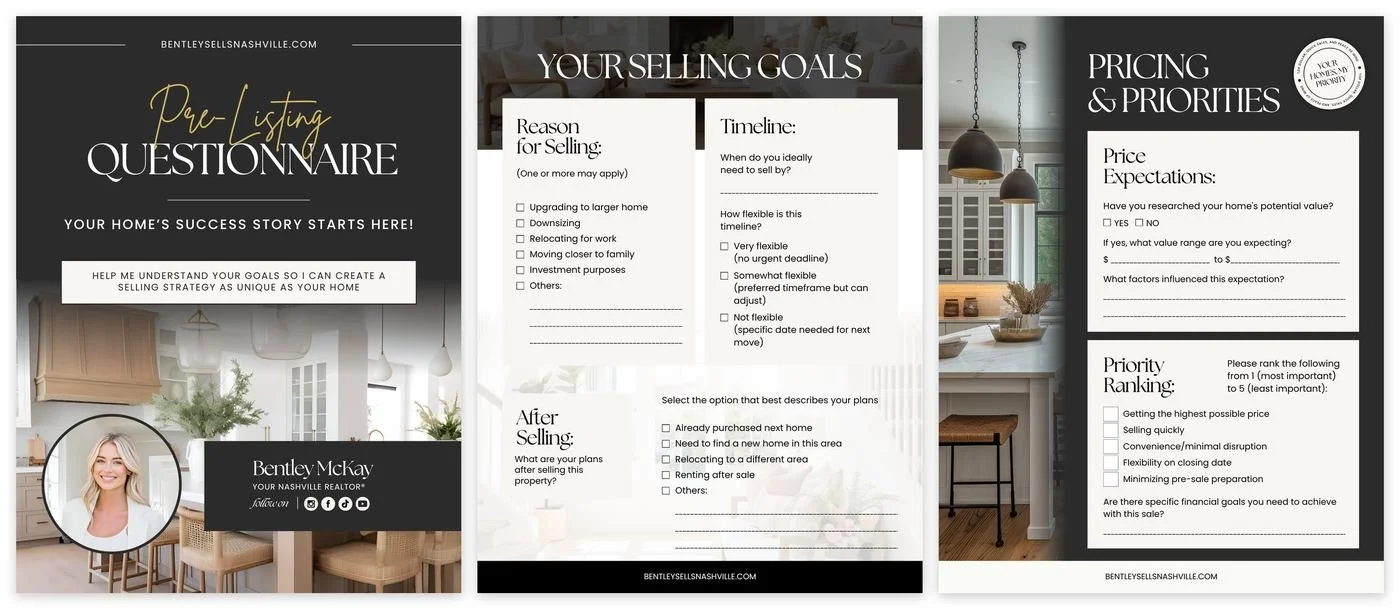
This is the one piece you want back before the appointment. It asks about the home's details and recent improvements, why they're selling, their timeline, and where they're going next. Then come the questions that are awkward to ask cold at the kitchen table: what price they expect and where that number came from, and how they rank what matters, from the highest price to a quick sale to the least prep.
It also covers showings, pets, known issues, what they'd rather keep out of marketing, any previous listing and what they think kept it from selling, and who's part of the decision.
Get their number before they see yours. If you can, email the questionnaire the day the appointment books. If it goes in the box, ask for their price expectation on the phone before they open the CMA, or seal the CMA in an envelope marked "Open when we meet."
The CMA packet (13 pages)
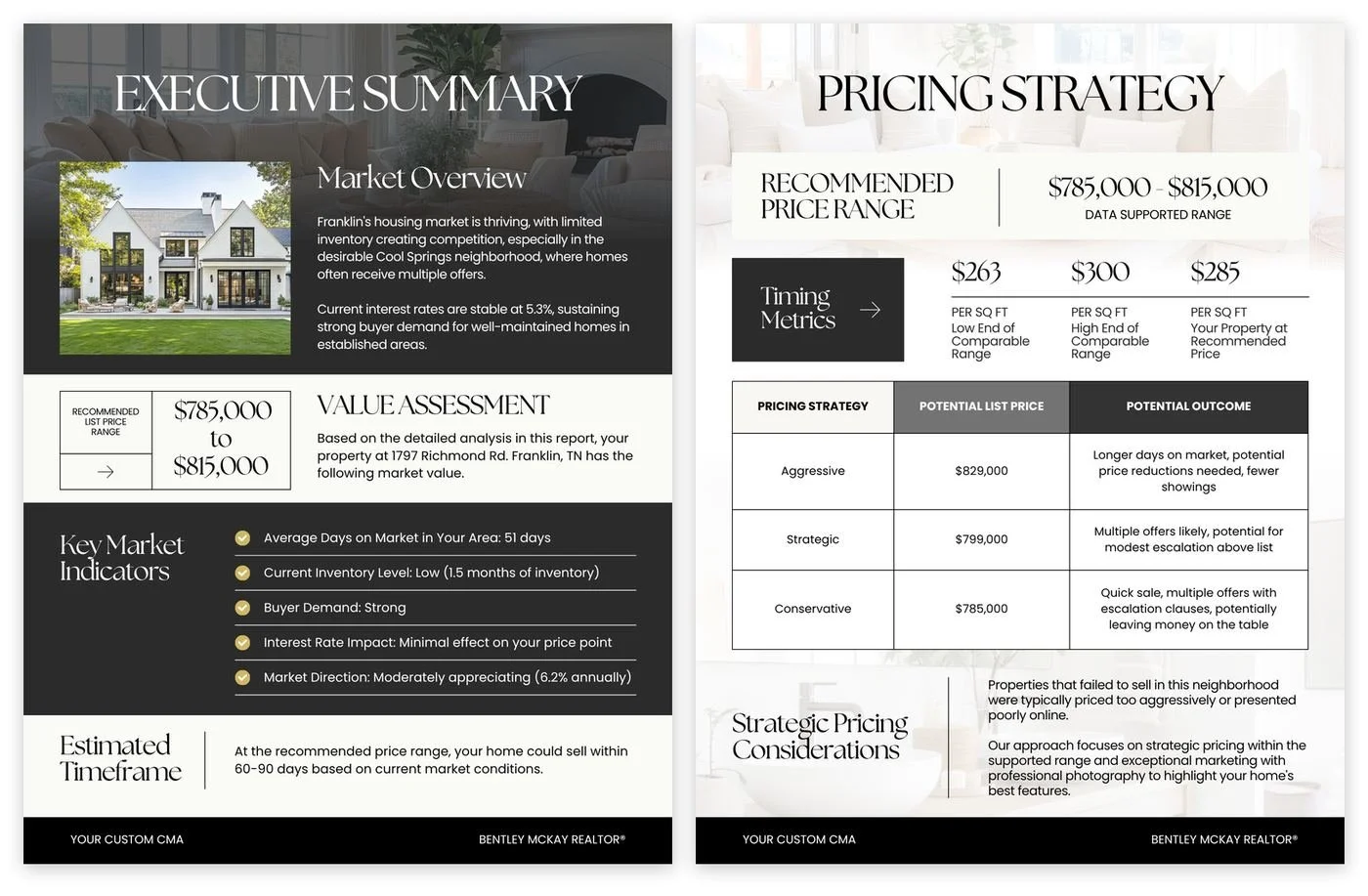
The seller sees your price range before you arrive, so the hour at the table is about how you got there. It's built as a report addressed to them by name: their property's details, a neighborhood market analysis, comparable sales side by side, the current competition, nearby expired listings, and a recommended range with three pricing strategies and what to expect from each. It ends with an estimated net proceeds page and a one-page executive summary.
You haven't been inside yet, so build it from MLS history, public records, and what they've told you. Before it goes in a box:
- Pull the condition assessment page. It lists concerns about the house, and putting concerns in writing about a house you haven't walked through is a bad way to start. Bring that page to the appointment and fill it in together.
- Delete what you can't source. That means the improvement ROI table and any interest rate or days-to-sell forecast, unless you can name where the number came from. Drop the "data supported" label if the range includes your own judgment.
- Every figure comes from your MLS. The sample numbers are placeholders, including the commission and concession rows on the net proceeds page.
- Add the Illinois disclosures. A written CMA has to include its purpose, a description of the property, your method, any assumptions or limits (like not having been inside yet), any interest you have in the property, and your name, license number, and signature. It also needs a statement that it's a comparative market analysis prepared by a licensed broker, not an appraisal (225 ILCS 454/10-45). The template has none of this, so add a page for it and get the exact wording from your managing broker.
Print the CMA yourself the night the appointment books, on heavy paper, and put it in a pocket folder with your name on it.
Listing appointment this week and no time to build the CMA? Book 10 minutes with D.J. and we'll work out what goes in the box for that seller.
Optional: the seller's net proceeds sheet (1 page, two versions)
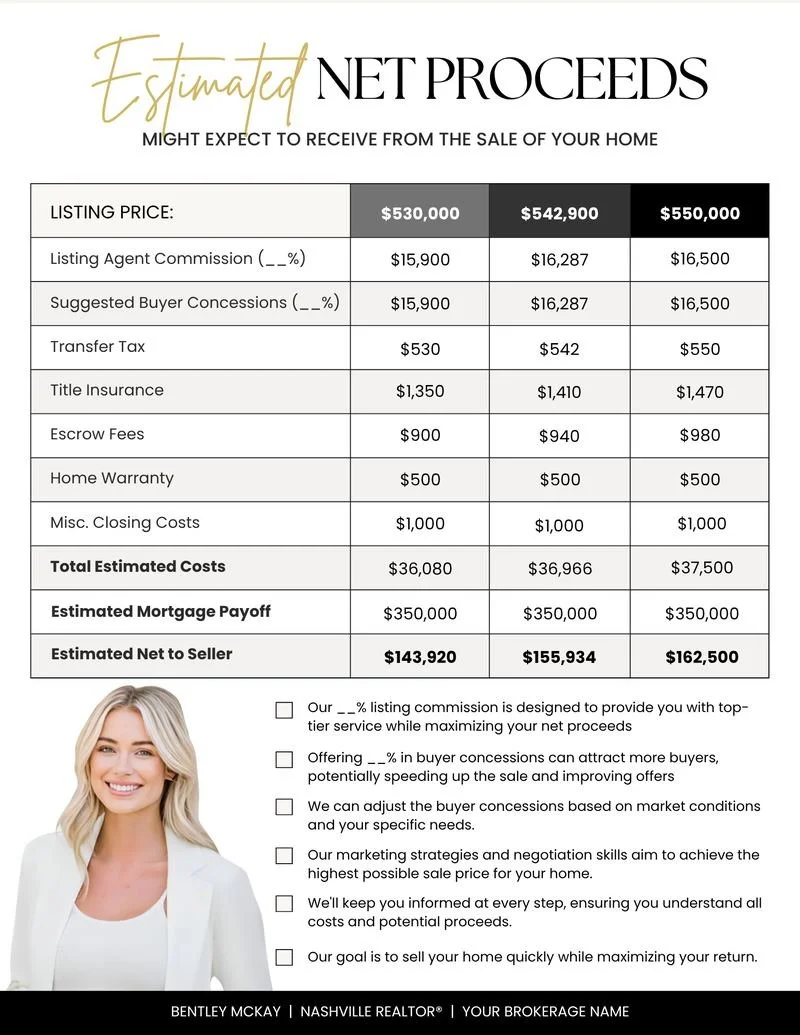
The CMA ends with its own net proceeds page, so you only need this sheet if you're not sending the full CMA. It shows three list prices side by side and subtracts commission, buyer concessions, transfer tax, title and closing costs, and the mortgage payoff, down to an estimated net at each price.
Fix three things first. The sample fills the commission and buyer concession rows with 3 percent of the price, so delete both. Commissions aren't set by law and are fully negotiable. Enter the rate you'd propose for this seller, or leave the row empty for the conversation. Whether to offer a buyer concession, and how much, is the seller's decision, so leave that row at zero unless they ask to see one. Line items and who pays them vary by state and city, so check them with your managing broker or a local title company or attorney. And you won't know their mortgage payoff, so ask on the phone or label that row for them to fill in. Mark the page as an estimate.
The "Why choose me" flyer (1 page, five color versions)
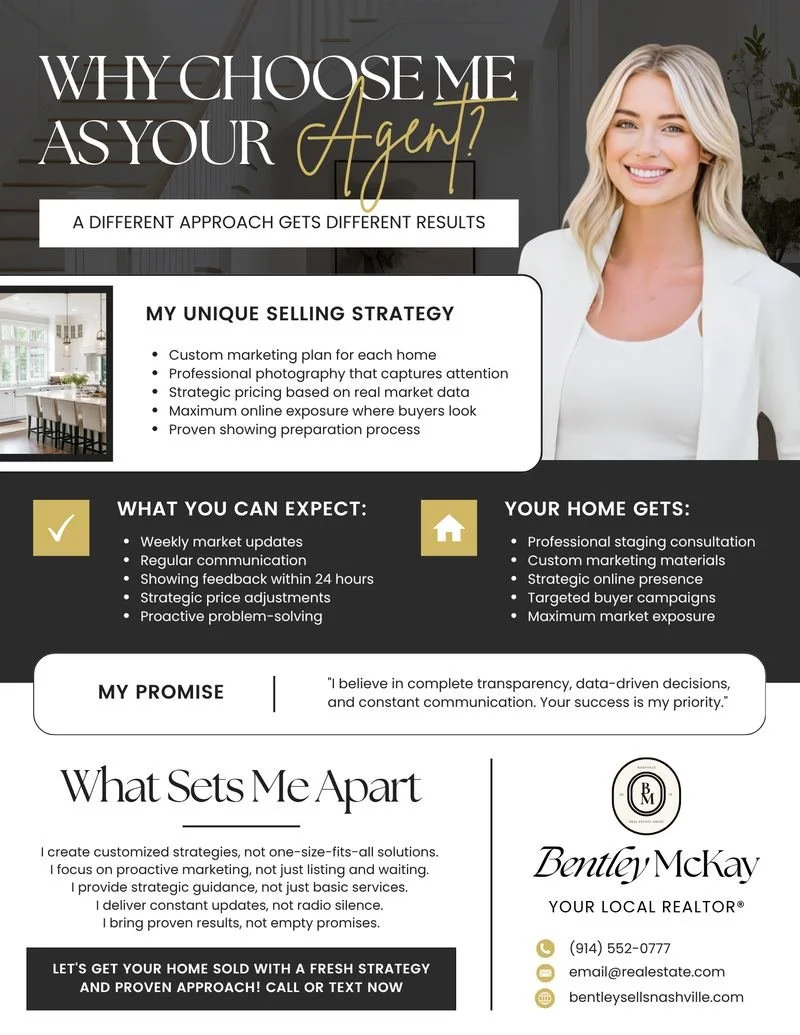
One page on what you do differently: your selling strategy, what the seller can expect, what their home gets, a one-line promise, and a short "what sets me apart" paragraph next to your contact information and a QR code. Pick the color version that matches the rest of your box.
Every line is a promise, like "showing feedback within 24 hours." List only what you do.
The note and the gift
Put a short note on top, written and signed by hand, that says you're looking forward to the appointment and names the day. Add something small from a local shop. If you're shipping it, pick something that won't go stale, like whole-bean coffee from a local roaster, and nothing with your logo on it.
Order the packet as bound booklets in batches and print the flyer on heavy stock. The CMA gets printed at home the night the appointment books. Leave out the listing agreement, because it turns the box into a pitch.
Move 3: when it lands, and the call after
Aim for the box to arrive one or two days before the appointment. Earlier than that and it's forgotten. Later and it may not get opened.
Plenty of appointments book for tomorrow, so don't build the box after the appointment is set. Keep three or four built with the packet, the questionnaire, and the flyer. When an appointment books, write the note, build the CMA, and drop the box off yourself. If it's tomorrow and you can't build the CMA tonight, send the box without it and bring the CMA with you. If the house is too far to drive, send it overnight with tracking. A box that shows up the morning of the appointment still beats no box.
The day it arrives, call. Keep it short:
Did the box get there? Is there anything in it you'd like me to come ready to answer on Thursday? The call the day the box lands
While you have them, ask three more things: "What do you think the house is worth?" if they haven't opened the CMA yet, "Will everyone who's part of the decision be there Thursday?" and "Are you talking with anyone else?" If a decision-maker can't make it, move the appointment rather than present twice.
If they've looked at the CMA, they'll have questions about the range. Don't argue it on the phone:
Write down every question you have about the range and we'll start there Thursday. I'll show you exactly how I got it. When they push back on the price before the appointment
Then open the appointment with the box, not your presentation:
What stood out to you in the box? The first question at the appointment
Start from whatever they bring up. If they haven't opened it, don't make it awkward. Say "Let's open it together" and walk them through it. If they've already met another agent, ask what that agent told them, and use the box to show what you'd do differently.
Bonus: what you give them after they sign
Four more templates are on the bonus page of the PDF. They don't go in the box. Hand over the first three at your listing kickoff, and the timeline once you accept an offer. It gives your new client something from you right after they hire you, when they're deciding whether they picked the right agent.
The home sale prep guide (20 pages)
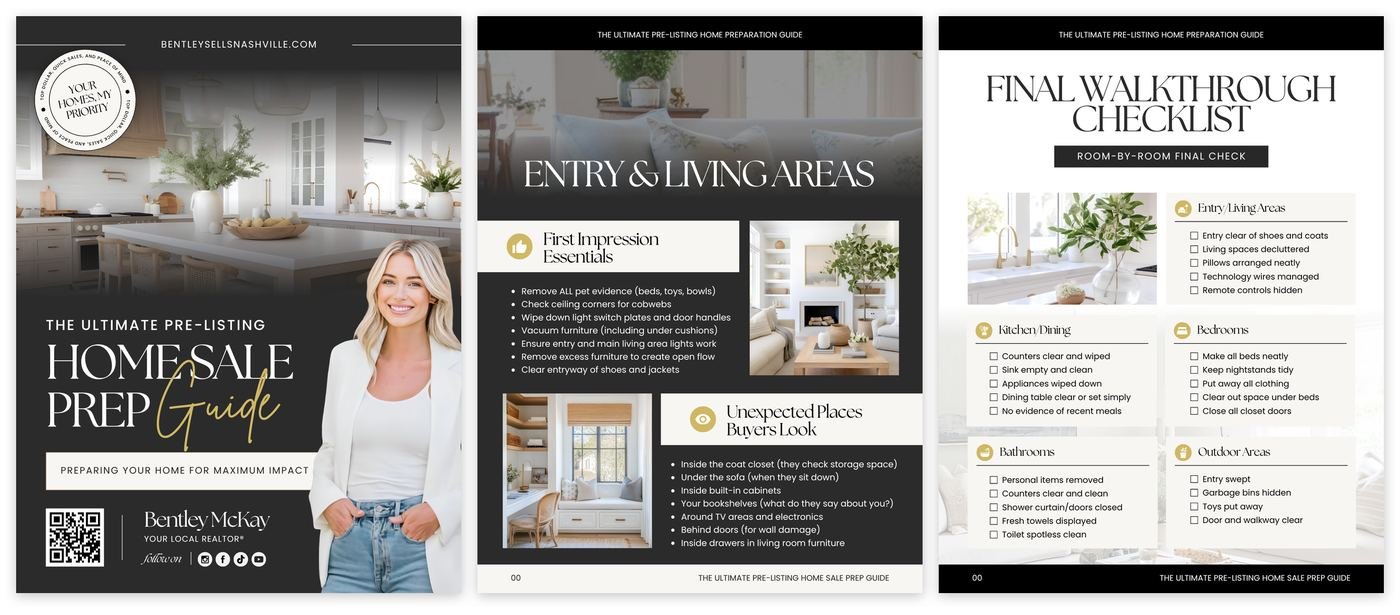
A room-by-room guide to getting the house ready: entry and living areas, kitchen and dining, bedrooms and closets, bathrooms, outdoor spaces, and the garage. Each room lists what buyers notice first, the spots sellers forget (under the sink, inside the refrigerator, behind doors), and what not to worry about, like minor scuffs or older appliances that still work. That last list keeps them from spending money on things that won't matter.
It also covers living in the house while it's for sale, with notes for working from home, kids, pets, and hobbies, plus a fifteen-minute plan for showing day, locking down smart speakers and computers before strangers walk through, and a final walkthrough checklist. It's your advice with your name on it, so read every page and change anything you wouldn't tell a seller yourself.
The staging checklist (3 pages)
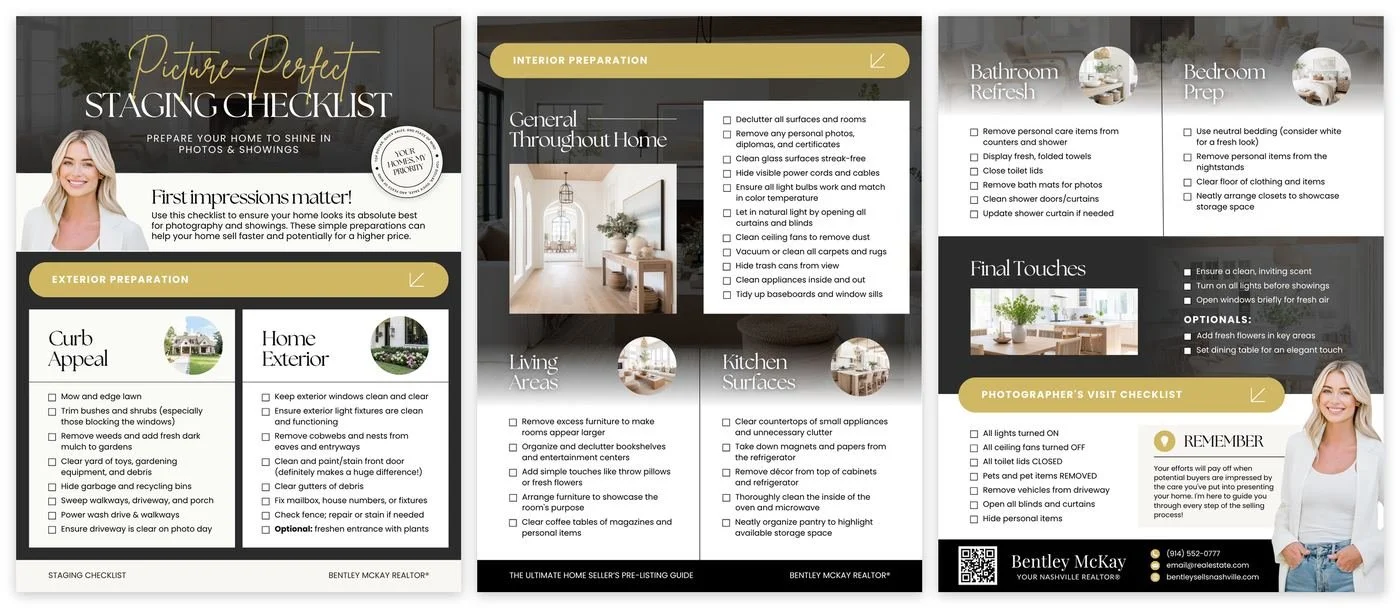
It covers curb appeal and the exterior, then every room inside, final touches, and a photographer's visit checklist: every light on, ceiling fans off, toilet lids closed, pets out, cars off the driveway, and personal items put away.
Showing instructions and guidelines (2 pages)
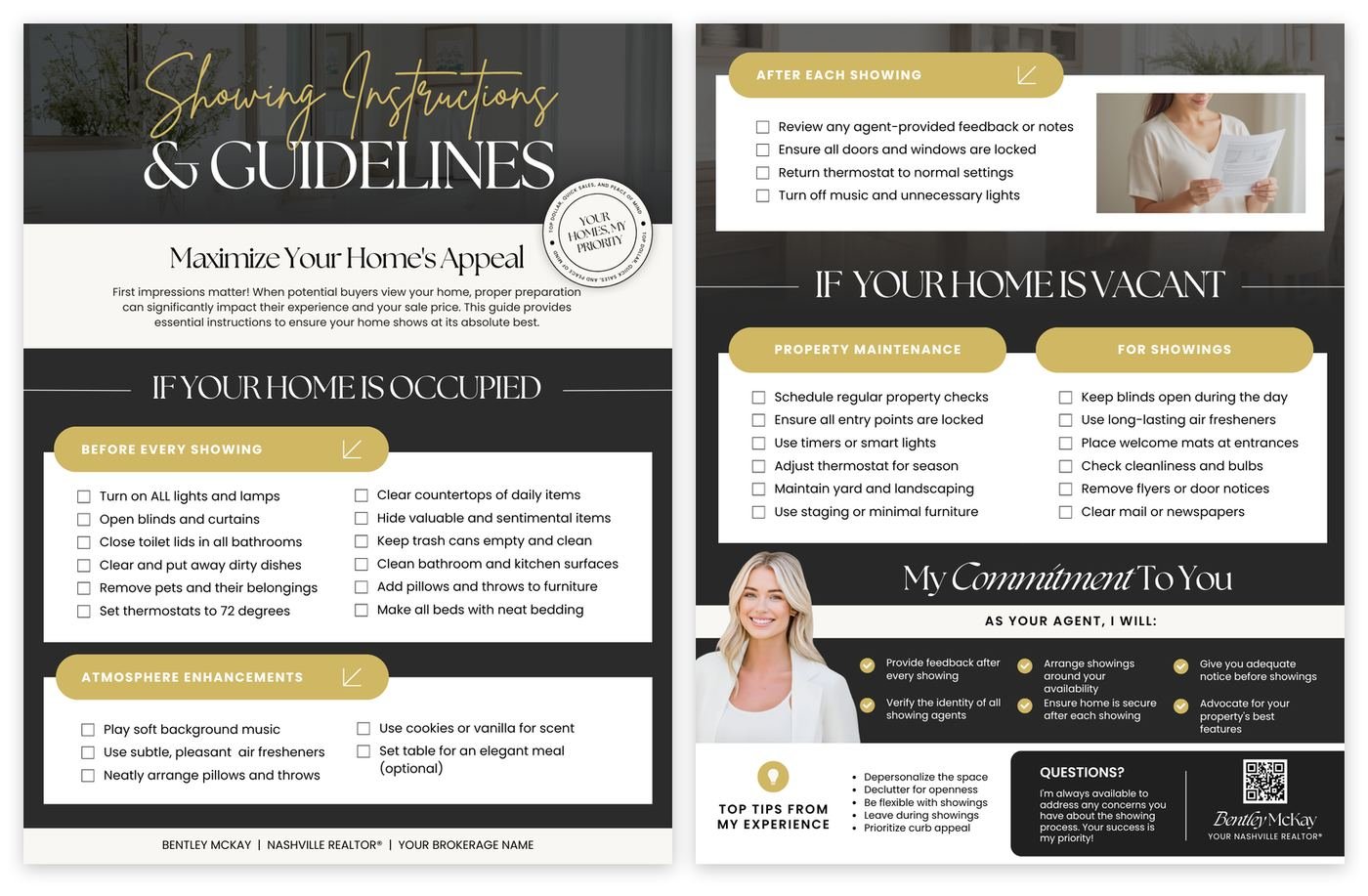
What the seller does before and after every showing, with a separate section for a vacant home. The occupied-home list covers lights, blinds, dishes, pets, valuables, and temperature. The vacant-home list covers regular property checks, locks, timers, and keeping the yard up.
The second page has a "My commitment to you" section: feedback after every showing, verifying the identity of showing agents, making sure the home is secure afterward, and giving notice before showings. Same rule as the flyer.
The under contract timeline (1 page, two versions)
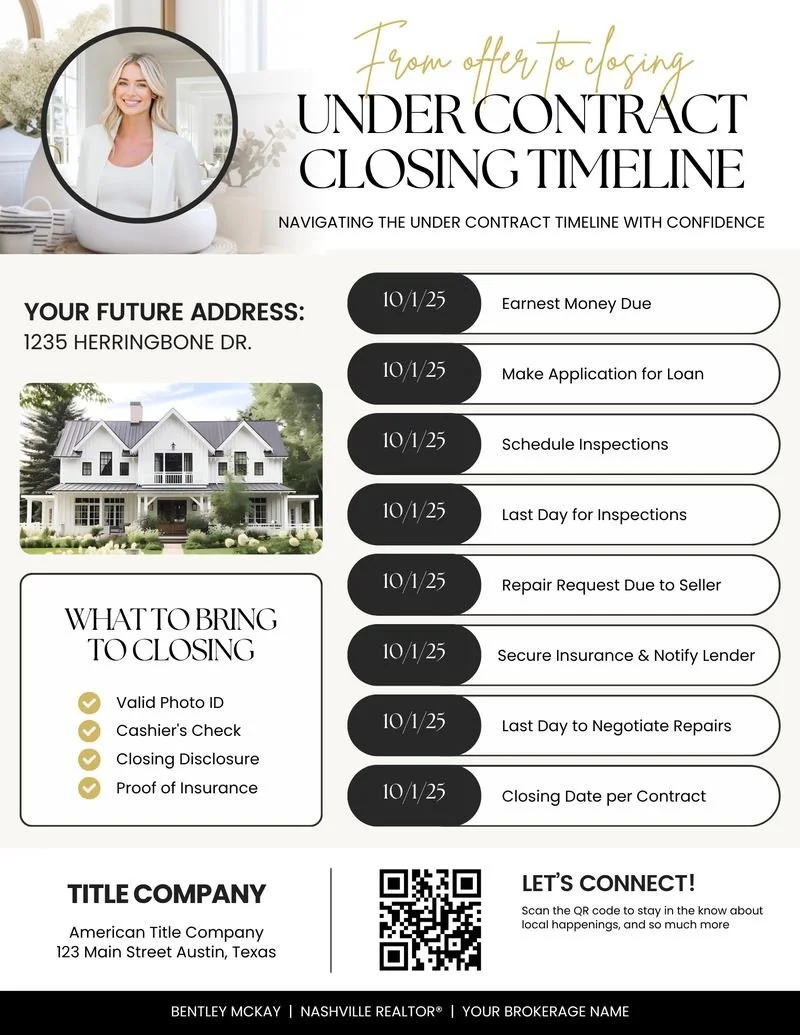
One page that shows what happens between an accepted offer and closing, with a date next to each milestone: earnest money, the buyer's loan application, inspections, the repair request, insurance, the last day to negotiate repairs, and closing. There's a block for what to bring to closing and one for the title company.
As it comes, it's written for a buyer ("Your future address"). Retitle it for your seller, swap in the milestones from your contract, and fill in the real dates once you're under contract. In the Chicago area, add attorney review.
Do this today
Download the templates and put your name, photo, and brokerage on the box cover and the pre-listing packet. Then email the questionnaire to the seller for your next listing appointment.
Ready to meet with D.J.? Book 10 minutes
Tell me when your next listing appointment is and who you're up against, and I'll help you figure out what goes in the box for that seller. I call you, it takes 10 minutes, and I won't bring up Kale unless you do.
What's in it for me: I recruit agents for Kale Realty, and I'd rather say so than have you wonder. If you ever leave your brokerage, I hope we're your first call. The templates are yours either way.
Rather text? 312.238.9796
Who this works for, and who should read something else
Do this first if
- You're getting listing appointments and losing some of them to other agents.
- You know the seller is interviewing more than one agent.
- Your appointments run long because you're selling the whole time.
- You have an appointment on the calendar in the next two weeks.
- You'd rather build something once than rebuild a pitch every time.
Read something else first if
- You're not getting listing appointments at all yet. Start with how to get more listings.
- Your sellers won't move because of their mortgage rate. That's rate-locked sellers.
- You win the appointment and then lose on fee. That's the commission conversation.
- Your past clients should be sending you sellers and aren't. Start with referrals from past clients.
Have a listing appointment coming up? Book 10 minutes with D.J. I'll call you, and I won't bring up Kale unless you do.
Frequently asked questions
What is a pre-listing box?
A pre-listing box is a physical package a listing agent sends to a seller before the listing appointment. It usually holds a pre-listing packet that introduces the agent, a questionnaire about the home, a CMA with a price range, a one-page flyer, and a handwritten note. It arrives before the agent does, so the seller has seen the agent's case when the appointment starts.
What's the difference between a pre-listing package and a pre-listing box?
A pre-listing package is usually a PDF or folder sent by email, and a pre-listing box is a physical package delivered to the seller's house. The contents can be the same. The box is harder to ignore, because it sits on the counter, while an email competes with everything else in the seller's inbox.
What should I put in a pre-listing box?
Five things: a handwritten note, a pre-listing packet about you and your marketing, a pre-listing questionnaire, a CMA with your recommended price range, and a one-page "why choose me" flyer. Add something small from a local shop. Save the prep guide, staging checklist, showing instructions, and under contract timeline for after the seller signs.
Should I include a price or a CMA in the pre-listing box?
Yes. A CMA shows the seller a price range and an estimated net before the appointment, so the hour at the table is about how you got to the range. Build it from MLS history, public records, and the seller's answers, leave the condition assessment for the walkthrough, and ask for their own price expectation before they open it.
Does a CMA need a disclaimer in Illinois?
Yes. Under 225 ILCS 454/10-45, a written CMA must include its purpose, a description of the property, the method used, any assumptions or limits, any interest the broker has in the property, the broker's name, license number, and signature, and a statement that it is a comparative market analysis prepared by a licensed broker and not an appraisal. Confirm the exact wording with your managing broker.
What should I give a seller after they sign the listing agreement?
A home sale prep guide, a staging checklist, and showing instructions at the listing kickoff, then an under contract timeline once you accept an offer. Handing them over right after the seller signs gives your new client something from you when they're deciding whether they picked the right agent.
What goes in a pre-listing packet?
A pre-listing packet usually has a letter to the homeowner, an introduction to the agent or team, local market insights, case studies of recent sales, the marketing plan, how the selling process works, client reviews, and a page on preparing for the listing appointment. Keep only the pages you can fill with real, sourced information.
What is a seller's net proceeds sheet?
A seller's net proceeds sheet estimates what a seller walks away with after a sale. It starts from a list price, subtracts commission, any concessions, taxes, title and closing costs, and the mortgage payoff, and shows the estimated net, often at three prices side by side. Line items vary by state and city, commissions are negotiable, and every figure is an estimate.
What should a pre-listing questionnaire ask?
A pre-listing questionnaire should ask about the home's details and recent improvements, why the seller is moving and on what timeline, their price expectations and where they came from, what matters most to them, showing access and pets, known issues, any previous listing, and who is part of the decision. Send it before the appointment if you can.
When should I send a pre-listing box?
Send it so it arrives one or two days before the appointment. For appointments that book for tomorrow, keep a few boxes built ahead of time, add the note and the CMA that night, and drop it off the next morning. If there's no time to build the CMA, send the box without it and bring the CMA with you. Call the day it lands.
What size box should I use?
The free templates on this page come in 12 x 10 x 4 inches, which fits the booklets plus a small gift, and 12 x 9 x 2 inches, a flatter box for paper only that's cheaper to ship. Pick one size and stick with it, so reordering is never a reason to skip a box.
How much does a pre-listing box cost?
It depends on three things: the printed box, what you put inside, and shipping if you don't deliver it yourself. Custom printed boxes usually have a minimum order, so if you only have a few appointments a year, start with printed labels on a plain box. Get a quote for your size and quantity and weigh it against what one listing earns you. The templates here are free.
Do I need a pre-listing box for every listing appointment?
Chris sends one before every appointment, and that's the simplest rule to keep. If you only send them sometimes, you'll skip them when you're busy, and busy weeks are when you have the most appointments. Keep a few built and ready so the box is never the reason you skip one.
What do I say when I call after the box arrives?
Ask: "Did the box get there? Is there anything in it you'd like me to come ready to answer on Thursday?" Then ask what they think the house is worth if they haven't opened the CMA, whether everyone who's part of the decision will be there, and whether they're talking with anyone else. The call tells you whether they opened it and what's on their mind.
Does a pre-listing box work for a virtual listing appointment?
Yes. Send the box anyway and open it together on camera. Walking through the pieces with them gives the video call a structure, and the seller has something physical from you after the call ends.
Does the box need my brokerage's name on it?
Yes. A box with your name and photo on it is advertising. In Illinois, advertising must include your sponsoring brokerage's business name, at least as large as your own name or team name, and a logo alone doesn't count. Other states have their own rules, so show the design to your managing broker before you print.
Can I use these templates if I'm not at Kale Realty?
Yes. Put your own name, photo, colors, and brokerage on them. The templates are Canva designs, so you'll need a free Canva account to edit them.
About this guide. Published September 2026. This page describes marketing and business development practices for licensed real estate agents. It is general professional guidance, not legal, financial, tax, or career advice, and it is not a substitute for direction from your own managing broker. Your brokerage's office policy takes precedence over anything written here.
Anything you send a seller that promotes your services is advertising. In Illinois, advertising by a licensee must be in the sponsoring brokerage's business name and under the supervision of the sponsoring or managing broker (225 ILCS 454/10-30; 68 Ill. Adm. Code 1450.715). Other states have their own rules. Use client reviews only with the client's permission, and never offer anything in exchange for one. Chris's results are his own and are not a guarantee of any result for you.
In Illinois, a comparative market analysis must meet the content and disclosure requirements of 225 ILCS 454/10-45 and is not an appraisal. Net proceeds figures are estimates, and line items vary by location. Commissions are not set by law and are fully negotiable. The templates come filled with sample agents, properties, text, and figures, including commission and concession amounts, which are fictional placeholders and not recommendations. Comparisons and case studies you publish must be accurate, sourced, and dated. Use "REALTOR®" only if you are a member of the National Association of REALTORS®. Canva is a trademark of Canva Pty Ltd, and Kale Realty is not affiliated with Canva. Confirm current requirements with your managing broker before sending anything to a seller.
Kale Realty reviews and updates this page periodically. If you believe any information above is inaccurate, email dj@kalerealty.com. Published by Kale Realty, Chicago, Illinois.